Affichage des articles dont le libellé est Blended families. Afficher tous les articles

samedi 7 janvier 2012

All creatures

The "tortue"

Don't ask me its species. I don't know. It's something you're not allowed to buy in France, but if you look around online, you can find people breeding and selling them, and we wound up with one. I shan't say how. I don't need the law, on top of the stepchildren and everything else. This one came with one of the stepkids, his books, clothing and other miscellaneous belongings, when he moved from his mother's house into the orange room, out in the petite maison, three or four weeks ago.

At his house, he had an enclosure in the garden in which it lived, but I am told that it is too young to hibernate out of doors and must live inside. I didn't ask any questions, but the other day, when I went to retrieve the broken Eastpak backpack to take back to the store for repairs (really; they are actually sending it back to Eastpak for a new zipper, at no charge, in honor of the lifetime guaranty -- 25 years in France), I saw a cardboard box on the shelves, along with a portion of my English language book collection that made the move over here a few years ago, and I looked inside it. There was the turtle, lying on its back next to the bottom cup of a very small flower pot painted gold, given to me one Christmas in Greenwich by a friend, who died of lung cancer not many years later. It made the selection for the move. I turned him on his stomach, and sent a text message to my stepson.

"J'ai trouvé la tortue sur son dos. Je l'ai retournée."

"Cool! Merci," came the reply.

Today, I went in to check the electric heater, since the room will be unoccupied, and we are hypervigilant on consumption of all energy sources aside from protein and wood, and I glanced in his cardboard box; there was the turtle, lying on his back.

It was getting to be a habit.

He is bored, and he is trying to get out. When he pushes up straight against the side of the box on his hind legs, overambitious, he falls over onto his back, spreadeagled. There, he is perfectly helpless, until someone comes by and thinks to check on him. I am about to start calling him Gregor.

I righted him and carried the box into the house. He might die, but it won't be on my watch, if I can help it.

I was determined not to get attached to this creature. I have resisted the charms of the dwarf Russian hamster my stepdaughter retrieved from her mother's and repatriated here some weeks after she moved in, almost. I have resisted the rabbit, who has remained behind, altogether, and the cats are not even a question.  Check with me on the stepchildren themselves in a few more weeks. I placed him on the kitchen counter, and switched the cup from the miniature flower pot for the saucer of one of the espresso cups, reached for a little lamb's tongue lettuce, and set the whole thing on the table. I was watching him, when my husband and son walked in the door.

"Je l'ai trouvée sur le dos encore," I explained, not wanting him to think I had developed a sudden interest and tenderness for this little creature.

"Elle est mignonne, n'est-ce pas?" said my husband. There was no point. I had to confess.

"Oui, il suffit que je regarde une petite bête, et je suis perdue," I admitted. There has not been a creature I have been able to resist, large or small. I am not always successful with them, the rescues, I mean. The healthy and living pets is another thing. Almost.

We all sat down to our lunch, skillet macaroni and beef to cheer and comfort my suffering son, in exam period, and lamb's tongue lettuce for the little turtle. I'm not sure who ate with more appetite and abandon, but it might well have been the turtle. They eat a lot, my husband informed me. That's fine. I have a big bag of the lettuce.

Now, I have to look up proper indoor living conditions for the little one, and make sure he, or she, has what is needed. For the time being, it's in the house, where there is usually someone to keep it the right side up.
....

lundi 12 décembre 2011

Riding racehorses

On Strictly Rhythm

Saturday morning at Gina's yards in Maisons-Laffitte was one of those moments when you stop and realize not how far you have to go still, but how far you have come. In so many ways. But it is like that, when everything is a way to everything else.

Two years ago last July, my stepdaughter got on a pony for the first time, a Shetland, like all the kids do to start. Saturday, she mounted Strictly Rhythm, a 3-year-old thoroughbred racehorse, a filly by Hawk Wing and Esteemed Lady out of Mark of Esteem, who has placed in 7 of her 13 races over these two years. For the last year and more, she has been riding double ponies and jumping 60-70cm, although she has jumped more on occasion. In her two and a half years riding, she has gone from beginner to working toward her Galop 5. There are 9 altogether. To give you an idea, at Galop 5, you can join the mounted division of the gendarmes or the police. At Galop 7, you may qualify to teach, if I am not mistaken.

For anyone who doesn't ride and who may be excused for not realizing this, she has already progressed very rapidly, but to go from a double pony in a pony club, even a really good one, to a thoroughbred racehorse is like going from a Deux Chevaux to a Ferrari; you don't just show up at a trainer's yards and hop up into the saddle, and it's not for everyone. Nor do you earn your opportunity by mucking stables and greasing tack; you have to find a way to show the trainer that there is an excellent chance you can handle the horse, and yourself. First, there's the danger to you. Then, and very possibly more important to the trainer, there's the possibility of injury for the horse, a horse who earns money running, not recovering in its box.

For my stepdaughter, or ma belle-fille (it's so much nicer in French), the wait was relatively painlessly short and the way smoothed by a bit of good fortune. Gina was going to the farm in Normandy, the farm where Strictly Rhythm was vacationing, to hand a horse she was retiring over to her new owner, and we just happen to live a few kilometers from the highway to Orbec. Gina and I made an appointment to meet near the exit ramp of the highway, and we headed to la ferme de Madame Guibert, stopping along the way for Gina's usual "service station lunch".

It was only when we arrived near the farm at precisely the appointed hour and Gina called the girl to guide her the rest of the way, figuring she had to be nearly there and about to get lost, that we discovered that they were nowhere near. Her parents had hired a horse transport service, she and the driver had driven across half la France, and the driver had just stopped well over an hour away in Gaillon, at the appointed hour to meet in Orbec, for lunch, or to casser la croute.

"Je vais juste casser la croute," he said to Gina, perfectly nonplussed, "et puis on reprendra la route."

This is France. Nothing gets in the way of lunch, at lunchtime.

Just casser la croute and drive more than an hour and a half? It was 1 pm. They wouldn't be there for another 2 or 3 hours, and Gina was due back at 5:30 pm for evening stable. Seven horses would be waiting for her, so what the hell did he think he was doing, stopping for lunch an hour and a half away at the very hour they were supposed to be there? But there was more. The girl said that truck wasn't equipped for a horse. It was a stock transport truck.
"Stock?" Gina said. "Mais on parle d'un pur sang qui vient de terminer son entrainement de course!" A thoroughbred racehorse, who had just come off training. "Je ne peux pas le mettre dans un camion de stock."

The girl was in tears, stuck heaven's knew where for lunch with a driver who had just learned his empty truck would be turning around and driving back across France to somewhere nearly in Germany. I was imagining her sitting next to him in that cab for seven hours. Seven alternately silent and grumbling hours.

"Don't worry too much," said Gina, "kids today know better than ever before how to distance themselves. They all have iPods."

I imagined her slumped against the passenger door, pretending to sleep, music in her ears. It would have taken a lot more than an iPod for me to survive that at 18, even at well over 18, but we went to see Strictly Rhythm in her box and then out to see Clare, who is in foal, and we got back well ahead of time for me to go get my belle-fille from the pony club. Time enough, it turned out, for Gina to come up with me and see the place and say she'd like to see her ride right as Julie, the director, was walking by, said "Bien sur", and told my belle-fille to go get a helmet from the tack room. There was a lesson in the covered manege, and she could get on any of the ponies.

Well, you'd have thought she'd have jumped, squealing for joy, at the occasion, but that wasn't quite the way it went. I was ready to tan her hide; Julie ordered her; and, the girls in the lesson started to call to her to get herself in there and on a pony tout de suite. Here she wanted, hoped to ride for Gina, and she was dragging her heels. I was puzzled. I was vexed. Gina and I stood in the tribune next to Julie, and there she was trudging across the manege as though to the gallows, when a friend jumped off a pony and handed her the reins. She mounted. Gina watched, and she and Julie exchanged observations.

"Elle n'a pas la force de monter un pur sang cheval de course," said Julie. She doesn't have the strength to ride a thoroughbred racehorse.

"Il ne faux pas de la force, mais la main douce." You don't need strength, said Gina, but soft hands.

"Elle a la main vraiment douce," allowed Julie. She has very soft hands.

"Une plume comme cela pourrait être très utile," said Gina, watching all 38 kg of my feather of a belle-fille ride around the manege. "Ca va! C'est bien," she called out to her.

She'd ride for Gina, eventually, but it couldn't have turned out more perfectly. Alexandra might not have had her new mare in the truck on the way back across France, but my belle-fille had gotten a serendipitous audition.

Alone, later that evening, she looked at me and said, "Tu sais, j'ai monté le poney le plus facile."

"C'est pas grave, mais pourquoi tu as fais ça?"

"Parce qu'Alice avait besoin de faire pipi, alors j'ai pris Gladys. Et elle m'a dit que je suis folle; elle aurait sauté sur l'occasion de monter pour quelqu'un comme Gina pour la chance de montrer ce qu'elle sait faire."

I shook my head. Alice has more sense in hers. She probably made up the excuse of needing to run to the bathroom to get my belle-fille up on a pony as fast as humanly possible, and, was she crazy? She, she told my belle-fille, would have jumped at the chance to ride for someone like Gina and show her what she could do, all for a chance to ride thoroughbreds.

But, if soft hands are enough, it also takes assurance, maturity and confidence, but one way to develop all of that, and in spades, is to get up on that horse with blood and ride it, and Gina decided last week that Saturday would be the day. She asked me not to tell her, and we all kept the secret, the happiest of secrets to keep. My husband, too. I hoped it wouldn't give it away, asking her if she had her helmet and chaps leaving the house, but, I reminded myself, I have asked her the past three Saturday pre-dawn mornings.

At breakfast, she was willing to eat a scrambled egg with her cereal without milk.

"J'ai fais un rêve ce matin," she said.

"Un mauvais ou un bon?"

She had been in a miserable mood when I woke her up, smothered in the heat from the electric heater she'd turned up and left on full-blast, and she'd fallen back to sleep and then brought me up short for "interrogating" her upon awakening, for the second time in a half hour, when I asked her a question. Chastised, I had left her room again, hoping for the best on the morning she was to ride for the first time. I suspected a bad dream.

"Mauvais à la fin, mais j'ai rêvé que Gina m'a tendu Hard Way, et j'ai été sur lui, et il y avait beaucoup de monde. Lisa était là sur Vedette."

I smiled. She had dreamed that Gina handed her Hard Way, her favorite in Gina's yards, to ride, and there were many people there watching. Lisa, her friend from the pony club, was on Vedette, the Welsh pony she has begun to ride in competition. She didn't mention the bad end.

"C'est drôle les rêves," I replied, "Quelques fois on rêve le futur, son destin, l'où on va et ce qu'on veut. Toi, tu vas vers les purs sangs de courses, et tes amies sont toujours montées en poney."

She returned to her eggs and orange juice, and we headed out the door to her future, come as quickly as she could dream it. We cleaned boxes like every Saturday, and she brushed horses and greased hooves to get them ready to saddle; spread fresh straw; fetched hay and clean water, and then Gina came up to us where we stood near Hard Way, about to go out for his exercise.

"Ce matin, j'ai besoin de ton aide. Tu vas monter. Pas Hard Way. Il met son poids dans les mains, mais tu monteras Strictly Rhythm. Elle est gentille. Ca te vas?"

My eyes didn't leave my belle-fille's face. I wanted for all the world to have my camera in hand the moment Gina told her, but it would have been a dead give-away. Instead, I watched her. Her eyes opened wide and softened, she continued breathing, but a smile started to trace its way across her left cheek. She nodded.

"Tu as tes chaps et ta bombe, oui?" She nodded again. "OK, vas te préparer."

She headed into the tack room for her stuff, and I heard her call out to me, "Tu le savais, n'est-ce pas?" You knew, didn't you?

"Ahhhhh...!"

"Tu mens super mal!"

Gina looked at me over Hard Way and raised an eyebrow.

"Je n'ai pas menti! Comment j'ai pu mentir quand je n'ai rien dit?"

But, she didn't mean that I had lied before, of course. She meant I couldn't lie right then, about not having known, when there was no way I could hide the pleasure I took in being caught out, or the pleasure I took in watching her step up into the saddle.

"Tu es fière d'elle," I heard Thierry, one of the owners who lends a hand around the yard, say. Looking over, I saw him smiling from ear to ear. He's a father. I turned and glanced at the young woman from the International Racing Board, who had come out to see Maisons-Laffitte, and who had been riding her parents' race horses in England -- in her Wellies, no less -- "forever".

"Je suis heureuse," I said, turning to Thierry, and returning his smile, watching his eyes turn back to Capucine across the yards, "Heureuse qu'elle ait eu cette chance."

The young woman smiled, and we all turned back to watch her ride away out beyond the stables and out the gate with Gina.

"It went well, I think," said Gina while we were finishing up.

Later, in the car, I interrogated her for real, and she cooperated this time.

"Alors, qu'est-ce que vous avez fait?"

We rode into the park at a walk, and we trotted, and then Strictly Rhythm broke into a little canter, and Gina said she was trying to wake me up, and then we cantered, and she got away from me.

I knew that. She had already told me. When I asked her if she had gotten her back under control, she'd flipped at me, cool as a cucumber, "Well, I wouldn't be here if I hadn't, would I?" Cheek. So, it was good for her.

"Alors, dis-moi. Comment l'as-tu rattrapée?"

I pulled my shoulders back and stuck my feet out forward, toes straight up, like Gina told me, and I remembered, just in time, to lower the reins to the neck, like Gina always says you must. Never raise the reins, they'll go faster! Gina laughed. 

Phew, I thought.

I didn't ask if she wanted to ride again. That wasn't necessary to ask, but next Saturday, it might be off to the races at Deauville to see 2-year-old Surrey Storm, a Montjeu filly, run her first race in France, if she doesn't get eliminated. She has run four times in England and placed in three of those outings, two third places and a fourth, finishing at worst in eighth place. I might even put a fiver on her if she goes.


....


jeudi 17 février 2011

Stephearts and Valentines

My recent reading material
(Flora McEvedy's book is terrific, by the way)


I have been reading. A lot.

And I have been thinking. Even more.

I grew up a child with a mother and a father, and a stepchild with a stepmother and a stepfather. I am now an adult with another parental divorce under my belt, resulting in another stepmother, who has grandchildren. That's manageable, though, since my first stepmother wasn't very interested in the job. Neither was my father in his, for that matter. At least not with the children from his first marriage. His own stepdaughter from his second wife's first marriage and daughter from his second marriage were another story, however.

Following me still? I suspect it's easier and easier to follow these divorce-split family trees. The forest is growing since parents haven't really gotten that much better at marriage since I was a kid, but haven't given up on it altogether, either, and more and more of us needed extra holidays at school to celebrate (or not) all of the adults who participated (or didn't, finally) in our parenting, and extra sheets of paper to get all those branches in.

Given the weakness of the branches of my own family tree with its split trunk, it is perhaps not surprising that I crashed through into the branches of another similarly broken family tree, although you would think I might have been smarter. The single life was not all that bad in hindsight, which, as we all know, is 20/20, but hope springs eternal and somehow we seem driven to move into the married state. I am now the wife of a husband with two exes and stepmother to five children, ranging in age at the time I married him from five to nineteen; three from his first marriage, and two from the relationship that followed.

In the months before we finally left the States for our new home in France, my son asked me one day, "OK. So, if the oldest are 16, 18 and 19, and the youngest are 8 and 5, then I will be in the middle, right?" We were both enthusiastic about our anticipated Brady Bunch family. I believed I was prepared.

Had I not, after all, voluntarily participated in a number of sessions of family and individual therapy over the course of my post-parental divorce life? Had I not read many books prior to my last shopping spree on Amazon.co.uk for literature on the stepfamily? Had I not survived, thrived (after a manner), and even managed single-parenting rather well? Had I not known my husband for many years before we married? Were we not two intelligent and loving people surrounded by friends and family?

Or, was not that just the problem?

If stepfamilies are a special challenge, they are not all equal, and after my latest reading I have realized that if the challenges they throw at you can be measured on a scale of 1 to 10, with 1 being a walk in the park and 10 being stepfamily hell, ours isn't even described in the books. Vague reference is made to that sort of situation, The stepfamily that cannot be named. You can feel the author tremble and shy away from going there.

Those of us who have, however, found ourselves there are left in Hansel and Gretel's forest, not Pooh Bear's Hundred Acre Wood. We have a choice, though: we can succumb to our fear and despair, or we can find our inner Frodo. To escape my own early adolescent stepfamily forest, I walked to school many a winter morning, pretending the hair on my toes meant I was a Hobbit, and I could manage my way along the wood on the way to the middle school, walking absolutely silently in my mother's old red leather clogs. You can be at peace in a forest, if you go deep into yourself.

And so I waited for my newest books to arrive, and then I read, made notes and underlined text, looking for the crumbs that would lead me onto the path out of the forest and to a home, sweet home. I was full of the inspiration, guidelines and support I felt I needed to better take on my stepdaughter's residence in our home, and so I fell from my fragile branch hard when she shook our tree with all her adolescent might Valentine's Day. I had (I had read) done so many things more right than my husband believed. What had gone wrong? I asked myself, driving aimlessly from village to village in the dark, wondering if Formula 1 accepts dogs as well as reservations and credit cards in the slot at the door.

You fell for it again, said my saner, more realistic self. The one who saves me on a regular basis from myself, the one who thinks I am all powerful. You believed that you were powerful enough to make up for all the evil of "the bio-maman who cannot be named". You alone cannot. You with the rest of the world combined probably couldn't either.

See? It was true. I had wanted to step in and make everything better, including things no one can make better for one's stepchild because we are the stepparent, and yet we have to try and do our part, as awful as it makes us feel most days, and as badly as it shakes our family tree on the worst of them.

You cannot take the place of her mother, as wonderful as that would be for everyone. And, you do have to go home and face it with your husband, just like Sam said, said my sane self, very calmly.

I had driven from the house, dogs and their food and measuring cups added for additional proof that I really did mean to leave. I did. I really wanted to. I have really wanted to more times than I can count, and the urge gets stronger and stronger. It has become a full-fledged fantasy in vivid color and detail. I can see it. I almost know exactly how I would do it. Rapide was whimpering alone in the back end, and Fia was sliding back and forth with each turn on the leather backseat, trying to keep her head on my coat for a pillow, while I felt colder and colder in my shirtsleeves.

I had not packed nor dressed appropriately to run away from home. I had also, I realized, forgotten the dog food bowls.

That was when my cell phone started to make the bleating sound it does when the battery is about to die. I had failed to foresee this, too.

I held it in my hand and thought about who I could call and where I could go. I was dressed badly, had no luggage and two dogs. The choices were not many. Worse, support among friends and family for our monstrous stepfamily has been thin. From those who probably believe I deserve everything I am getting for making his ex miserable (it's her fault) to those who don't, but who do enjoy thinking that my dynamisme and positive, up-beat self will be more than enough to see me through the roughest patches of the deepest, darkest forest with aplomb and scarcely a scratch in my nail polish (works wonders to keep me from trying to cry on their shoulders), that didn't leave anyone, really, to call. So, I did what was left to do; I began crying. Hard.

I cried through Bennecourt and La Roche-Guyon, and on into Vétheuil. Rapide whimpered along, and Fia went on sliding back and forth on the backseat as I wound through the country road, the ronds-points and the sharper turns in the old villages, confounded by her cheerful and confident mistress' newly discovered misery.

I found myself in a parking lot in Vétheuil by accident, having missed the turn onto the main road.

You'd better watch it. You could have gotten hit from the side there, you know, and you have already been rear-ended tonight, said myself, as I looked around the parked cars blankly, wondering how I had managed not to even see the road.

"I am sure that had there been a car, with its lights on no less, coming from my right, I'd have noticed the road," I said, pretty defensively.

Maybe that was what shook me out of my pity party, but as I drove out of the village and up the steep hillside toward Fontenay-Saint-Père, I became calm. I love that rise up out of the valley of the Seine and onto the ridges that line it, like the crests of so many waves along the beach. From there, you can see the points of yellow light, gathered together into clumps, villages made distinguishable in the night. Each point of yellow light a window, with a life behind, or a street lamp, lighting pavement and homes.

My phone rang. I looked at the screen and heard it bleat its warning, "Appel Sam".

"Hi, Sam," I said in my most welcoming and upbeat voice. "What's up?" I could sense Fia relaxing, reassured by the return of the mistress she knew and trusted, while Rapide turned the volume up on her whining. Sam wasn't buying it either.

"Audouin told me you had a fight." My Disney facade crumpled.

"Oh. He did? How did he do that?"

"I called to see what happened with the woman who ran into us after I left you with her to get my train, and he told me."

Oh.

"That was really nice of you to call to check in and see how things went, Sam," I said, very sincerely touched by the sign that I might be at least a fairly good mother. My phone bleated loudly again. "My phone battery is about to die any second," I added.

"I know. I can hear it," he said.

In the end, it took 50 minutes for it to die, and I listened to my son's wisdom, good advice and realized that when I had cried thinking I could not ask for support, my need was heard. The exact right person called. That is a magic road for me.

As it turned out, he was the one my husband had thought to call when he needed support, only Sam saved him the call by calling at that moment himself to see how things had gone for me, and my husband told him. He hoped, he said later, that my son would call me. He thought, he said, that if I saw his name on my cell phone, I would answer. He was right.

"Et il m'a rappelé pour me dire que tu as oublié ton chargeur de portable, alors je pouvais compter que tu rentrais à la maison," he said, a grin starting to play at his lips. A little prematurely for my taste.

My son called him back after my phone went dead to tell him that I wasn't, and that I had forgotten my cell phone charger, so he could be sure I'd be coming home. My son had the wisdom not to share this with me. This is a truth about my marriage: my husband lacks this wisdom.

I did not drive straight home, though. I went and got gas and drove toward home, choosing to head up the ridge toward Bonnières and on to Vernon, Saint Marcel, Gaillon, Les Andelys and up the ridge to the ruined château, through Hennezis, Notre-Dame-de-l'Isle, Vernon again (the other side of the Seine), and Giverny.

Think about it, said my saner self, tourists from the world round come here just to see Monet's garden, and you get to live here nearby in France and drive through the middle of it when your world crashes down around you.

That was a way to think about it. It was, oddly, cheering. At least there were no lines.

I turned after Giverny and drove on to Villetz-Limetz, back to Bennecourt and over the bridge into Bonnières. I considered one last time the option of the Formula 1 over by the highway, temped by the idea of a room of one's own.

If they do have a no-dogs policy and there happens to be someone from the normally non-existent staff right there in the entry, you know Rapide will never move quickly enough to get past them unnoticed, said my reasonable self.

"Fia would. Maybe Rapide could stay in the car?"

Myself squinted at me. Rapide had finally quieted down and was snoring away in the back end, Fia was out like a light on my boiled-wool coat on the back seat, rocked to sleep by all those sliding turns, and I had turned the heat way up to stay warm.

You'd have to deal with getting back out again in the morning. Besides, you're almost home. It is your home, you know. Go to it.

"May I sleep in the guest room in the petite maison?"

Yes. You may sleep in the guest room.

"Alright."

I heard my husband clear his throat up in our room as I hastened the dogs across the terrace below, trying not to be heard. Rapide didn't get it, of course, why we were going into the petite maison, into a room normally off-limits to her no less, and I had to hiss, "Rapide, viens ici! Maintenant!" while Fia decided she had to drink from the old fountain-become-a-fish-pond. Noisily.

"Fia!" I hissed again, scaring Rapide away, "viens ici!"

They both trotted off to pee, or poop. Something. I heard paws scratching the dead leaves and moss-filled grass. I was exasperated. I was going to get found out and have to face my husband before whenever I would decide to do that.

"Fia! Rapide! Venez ici. Allez! Al-lez!" They pushed past me, two confused (one aggitated) dogs.

Rapide never really did calm down. She wanted to be in there. In the big house. Where she always sleeps at home. Fia gave me until nearly full light before climbing up on to the bed to cuddle.

Then, I faced my husband.

It was sad. Life settled sadly back into its tracks. I went to the grocery store in the evening, and I bought -- groceries. It was the day after Valentine's Day. Leaving my distraught husband in the dark in the middle of the garden the night before between his hysterical daughter and his furious wife, bereft of all happiness, I had shouted back over my shoulder, "Bon Saint Valentin!"

In the supermarket, I reached for a tablet of baking chocolate and headed for the cake decorations. I would buy a tube of that stuff with which you can write on a cake, and I would make a heart. A broken heart. I would rewrite and represent our household rules, and I would present the cake, offering her the tube with which to draw the lines to repair the heart.

That's kind of dumb, said myself. I mean, it's pretty out there symbolism. No one could fail to get it, and, well, it could backfire.

I thought about it. Quite a few minutes, squatting there in the day's "Madame la présidente" ensemble. I had had a meeting. At least I was presentable. That's cheering, even emboldening.

"I know. But maybe this is a symbol my husband would appreciate, even if his daughter rejects it," I said, putting the tube of glittery pink stuff into my shopping basket and heading for the check-out lines.

When I got home, there were red tulips on the table that I hadn't noticed earlier in the afternoon, when he had returned from the garden center with the fat wood for the wood stove. They were for me.

I checked.

Then, his son sprang on him that the message that he was not going out this evening had not sunk in and he did expect to be driven to his party. I supported my husband, explaining to my stepson -- following all the breadcrumbs the books describe with great care -- why it was important that he spend some evenings at home with us, and I supported my stepson, explaining to my husband why it wasn't reasonable to tell him that he couldn't go to a friend's 18th birthday party just because he needed to spend some quality stepfamily time at home.

My husband got the keys and drove him to his party, accompanied by his younger daughter, and I got busy on the cake.

The presentation of the household rules went down with great adolescent disdain. Undaunted, I pulled the cake out of the cupboard and set it in front of her after dinner. She squeezed her lips to suppress a smile, doing her best to look like it was the stupidest thing she had ever seen, and my husband practically emitted light, so much was he beaming.

"C'est quoi?" I asked her.

"Un coeur," she said.

"Un coeur fendu." A broken heart, added my husband, glancing up to me, "Un beau symbol."

"Tu veux le réparer avec ça?" I asked, holding the tube of glittery pink stuff out to her.

"Non," she said, shaking her head, determined not to give a centimeter.

My husband reached for the tube and began to squeeze glittery pink stuff onto the cake, connecting the broken lines. He got the top right, and then he connected the wrong ones at the bottom.

"Pas là," chided my stepdaughter, taking the tube from his hand. "Tu as fait les mauvaises lignes. C'est ici," she said, connecting the lines at the bottom to make the heart's point.

We don't know if she is still actually living with us (she moved in in early December and more or less out after my husband's last dispute royale with her mother two weeks ago, over discontinuing the child support for her, naturellement; it was her mother who practically begged us to take her, after all) or her mother (my husband says with us, bien sur, and she isn't pronouncing anything very clear), but a custody battle appears to be rising along with the bad moon.
....


mercredi 5 janvier 2011

Fault lines

At the Odéon


Cities have it over the countryside in the part of the winter when the snow is absent to make the mud and ugly green of winter beautiful under a pile of white. It is depressing, although not the only thing that is these days.

There is the dryer, for one. It has stopped working properly, and it's not the dryer's fault. It's the garage's fault. Which is to say, our fault, but I don't like to apportion that blame evenly. I tried to clean the garage, and I got in trouble for it.

"Je ne trouve plus rien," said my husband in his whiniest, most accusatory voice.

Where, in other words, had I dared to put his mess, and from where did those new shelves and plastic storage closet come? He knew that the old broken lamps, the bits of tubing and wire, the lengths of wood and sections of metal somethings or another, saved for the day when they would find their utility at long last, were not hidden in that new plastic cupboard. They had gone to the dump by the Fiatful, and I was to feel guilty for freeing up the floorspace to sweep clean of dust, dirt and dead leaves.

Où sont passés ma poussière, ma salté et mes feuilles mortes? I expected him to challenge me. J'ai gardé tout cela soigneusement dans le cas où j'en aurais besoin.

It takes courage to clean the garage, a storage shed, old unfinished shelves -- anything -- here. Cables to the 20-year-old Mac he hasn't used in 17 might one day find their utility, and I can be sure that I will catch hell for having thrown them out when that day rolls around in his senility. For a man who cannot remember a conversation a month before, he has a gift for recalling that he had 3 lengths of red wire he found on a sidewalk in Bergerac when he went to the market with his sister's friend visiting from Sicily under the metal shelves, behind the box with the boat model he began 23 years before, and it was very, very important to him. Having mustered that courage once, I am not liable to do it again for awhile, and, meantime, I can keep turning the dryer back on for three days until his socks and long-sleeve naturally dyed cotton t-shirts, the ones he likes, are finally dry, although a little funny smelling, while the towels, sheets and jeans pile up in damp heaps, waiting their turn.

You see, the dryer sucks air in from the floor, and with it, it sucks in all the dust, dirt, dry leaf particles and stray animal hairs, clogging the ventilation system and killing all possibility of the dryer drying anything, and to clean the floor I'd have to spend a week emptying the garage, searching fruitlessly for places to put everything we never need that is in there -- including several generations of bicycles in need of repair that no one has ridden in as long as I have been here, but which make an elevated surface upon which to pile more crap, like the cheap, give-away backpack his second son left here 13 years ago and hasn't thought about since, but which surely reminds his father of some moment. Or, it will surely just be useful some day.

Not that anyone would be caught dead with it. Possibly not even my husband.

It takes all kind of courage to clean a garage. Courage I don't have. And so, I fall deeper into despair, and from there to depression, waiting for the socks and cotton naturally dyed t-shirts to dry so I can put in the jeans, and then the sheets and the duvet cover, and possibly wash and dry our ski clothes before Sam and I leave on Saturday for Argentière. I know that is not happening. We'll be packing what I removed from the bags in August to pack the summer stuff for Dordogne, which will now have to come out so I can put the ski stuff back in them, which reminds me of the next reason for being depressed: the lack of dry closet space free of all traces of humidity and mold to put all those out of season clothes away.

One hundred years ago, closet space was unheard of. In our budget, armoirs are unheard of, and so we live in a circulating system of piles of useless stuff, out of season clothing and in season clothing still wet from the washing machine.

Then, for depression making, there is raising the stepchildren. I had lofty ambitions, surefire parenting philosophy in my store of arms, love for my husband to spur me, and a seemingly endlessly good opinion of my own strength of character and abilities, all of which I was certain would see me through to success. I forgot one thing: my stepdaughter's firmness of mind to try me. Nothing like it to drain the rest of one's resources to the dregs. It took only a little less than a month before I showed signs of stress, and just hours beyond that to split my resolve right along those fault lines as we pulled up to park the car, coming home New Year's Eve. In our space in front of the neighbors" across the street was a car with out of département plates. My husband sighed.

"Ils se sont garé dans nos places," he said.

For once, he said what I do when I see a visitor's car parked in our spots. He normally responds with "Elles ne sont pas nos places. Elles sont devant chez eux, et ils ont la gentillesse de nous laisser nous garer là," but tonight, he was taking my outlook on the situation. I nodded my agreement and sympathy as he began backing up to put the wagon on the sidewalk before our house.

"Leurs invités pourraient au moins se garer ici ou devant la mairie," I concurred, opening my door to step down before he eased the car tight against the neighbor's garden wall. And then, my stepdaughter piped up.

"C'est pas nos places. C'est devant chez eux, et ils ne doivent pas nous laisser nous garer là," she told me in the most icily, pointedly deprecating of tones. She was drawing her line in the sand, and it was clearly between her father and her on one side and me on the other. I felt my pulse quicken and a murderous impulse rise.

You must, I heard my more mature and wiser self interject with lightening reflexes, remain in possession of yourself at all times. That includes now.

"Alright," I said to that self. "Fine. I can do that," and I turned to my stepdaughter, who was slinking out of the car behind me, very clearly perfectly aware that she had fired a shot into the New Year's air.

"Nous avons un accord avec les voisins," I warned her off, "et de toute manière, ceci ne te regarde en rien."

The BMW slid into place along the neighbor's garden wall and she continued her slinking along the street wall of the house.

"Tu es insolente, et je te rappelle que ton insolence ne sera pas tolérée." You are, I informed her in the clearest of terms, being insolent, and I remind you that insolence will not be tolerated.

She stared at me, and then at the ground at her feet, trailing behind me as slowly as a human being can move while the two of us waited for her father to catch up with the keys to the house. He had heard most of the most unpleasant exchange, but I assumed I could trust him to find laudable motivations for her outburst. Just days before, in the heat of an hysterical fit, she had hurled words at me, words chosen for maximum impact (Ah! the intelligence of the hysterical and angry woman-child!), Je suis venue vivre ici pour voir mon père et tu m'empêches de le faire!

I have come to live here, she shot at me, to see my father, and you get in my way.

Cheap shot, myself said to me. The one I recognize as merely myself.

"Yeah," I agreed, watching her rail against me and trying not to smile, and wondering at myself for that in the midst of my own troops lining up, my own general ready to give the cry to engage. Who has not seen this before who has herself been a woman-child against the world?

Treat it seriously, myself cautioned. Any appearance of a smile will be taken as derision and met with rage.

"I know. Don't worry, anger is winning the upper hand here, anyway."

She was not here, then, as she had told us, to escape the endless conflict at her mother's home. Not, then, as we had believed, to find a more stable and structured environment to do her work of growing up. Not, then, as I could have believed from many comments over the past years, because here we put the children first and organize our lives around insuring that their needs are met. No. She was here because she wanted to see her father, a man who returns from work hours after she returns from school, hours I have cleared my life to make sure are available to her, to her school work, to her riding, to her peace of mind, while I am in the way of what she wants. Legitimate, but sucks for me.

These are realities that sit you hard on your bottom and dim the light around you, cause a loud buzzing in your ears, leave you with your forehead pressed against the cool mullions separating the panes of glass between you and the sodden, winter-ugly garden, feeling heavier and more toxic than mercury.

On her way up to bed on New Year's Eve, having told me precisely what I was worth to her in her early adolescent life, she called out in her winningest sing-song voice, "Bonne année, Papa! Bonne nuit, Papa!"

"Bonne année, ma chérie. Bonne nuit, et dors bien," he replied.

"It's normal," I hissed to myself. "Of course he wants to meet cheer with cheer, even if I am pointedly excluded. She is his daughter."

I limited myself to muttering all the way up the stairs, repeating "Bonne année, Papa! Bonne nuit, Papa!", imitating (with but the merest touch of mockery) her sing-song under my breath.

Very mature, said my better self.

She had been spoken to by her father for her outburst. I had not spoken to her since then, preferring to retreat to the haven of my room, with the piles of books rotating at my bedside like the piles of out of season clothes and bags at the foot of the bed. She would return from school soon, and I would be taking her to her riding lesson. I would do what I always do; I would tell her exactly what I think and feel.

"Tu maches du chewing gum," I said, watching her jaws work over in her seat. I hit the button and the window slid down on her side. "Tu sais ce que j'en pense de ça. C'est vulgaire. Avec moi, tu ne macheras pas du chewing gum. Tu peux le jeter." You know what I think of that. It's vulgar. With me, you will not chew gum. You can throw it out the window. Her eyes got big.

"Mais, ça c'est de polluer," she objected.

"C'est biodégradable. Que penses-tu arrive quand tu le mets à la poubelle et la poubelle part à la déchetterie? La même chose. Jete-le."

"Je peux le mettre dans un mouchoir," she said, removing a tissue from her pocket and folding the wad of chewing gum into it.

She turned the topic to why the French do not use recycled kraft paper shopping bags like they do in the States. A brief conversation led her to the conclusion that because they do this, apparently, in the UK does not mean that all English-speaking countries do the same; we tend to use biodegradable plastic bags, which are being outlawed there like they are here, in favor of reusable shopping bags that will eventually wind up in landfills. We rode around the small traffic circle and headed for the light. I did not turn my right turn signal on.

"On va chez McDo. Je te prendrai ton déjeuner que tu peux manger au club," I explained, keeping the unfriendliness from my voice. I was determined to be firm, but neutral, and I started again, while we waited for the light to change to green to cross, "Les relations sont fragiles,"I told her, glancing her way. She was looking at a point between her lap and the passenger window. "C'est comme un compte en banque. Quand tu mets quelque chose, tu peus en tirer, mais quand tu es dans le rouge, tu dois en mettre avant d'en tirer, et tu frôles le rouge." I glanced again as I said the last words, and I saw the smile play on her lips.

She knew. She knew exactly what I meant. Relationships are fragile, I told her; they are like bank accounts. When you have out something in them, you can take out of them, but when you have taken too much and you are in the red, you have to put back something back in again. You, I said, are very close to being in the red.

"Tu peux jouer avec Maman et Papa, mais pas avec moi. C'est comme tu veux," we drove up the rutted drive and pulled into the parking area at the stables. "Bonne équitation et à tout à l'heure."

"Merci," she said, as I handed her lunch to her after she arranged her bag with her gear on her shoulder. "A tout à l'heure." I watched her walk toward the stables, spot a friend over beyond the paddock. She raised her bag of McDo, and her friend broke into a run.

I had drawn my line in the sand, You can play with your mother and your father, but you can't with me. It's up to you.
....


vendredi 24 décembre 2010

Bending, a Christmas tale

Winter on the fields


As far as Christmas is concerned, the snowfall came too soon. The snow that covered the trees, bushes, fields and roofs is mostly melted here, although it still lies fairly thick once you pass Poissy and head into the Forêt de Marly toward Paris, where drivers, stuck in the heavy traffic, lowered their car and truck windows, pointed their iPhones toward the snow-covered tree trunks and branches and clicked.

"Ils n'ont que ça a faire," said my husband as his window slid down and he pointed his iPhone toward the white-frosted trees.

It was true. Sitting there in stop and go traffic on our way to the shopping mall in Versailles, there was nothing else to do but appreciate the winter forest landscape and take pictures. I hit the button again, and his window slid back up. The car in front of us moved forward a meter. The driver seated high up above me smiled over our way. I nodded slightly and smiled back. 'Tis the season.

There, the snow looked as though it had just fallen, where here, we only had the tiniest of flurries, hardly more significant than a delicate dusting of frost accumulating on the leaves that have not fallen and the crusty bits of melted snow that had hung on. Those minuscule flurries made me hope this morning, when I went down to the wood pile and peeled back the tarp to fill my rubber bucket, but now, there is no reason to hope for the white Christmas that seemed almost certain. Bright sunshine is forecast for Christmas day tomorrow, although temperatures will dip further below zero.

I also noticed that the frightfully overgrown yew down in the lower garden is still bent over to make an arched tunnel over the opening in the privet hedge, however, bringing it to within reach of my long-handled pruning shears. I ought to go down and prune it while I can, but at nearly 4 pm, it will be dark soon.

(I really ought to go clean up all the mounds of decaying dog pooh left apparent by the snow's withdrawal before it is too dark to see them. Not that anyone is at risk to step in it, over by the France Telecom utility building. No one but me and my dogs goes there, except whatever other dog on the poor diet it is who contributes his poohs without a similar contribution in clean-up by his master.)

When the snow was at its thickest on the branches and the tops of the clipped shrubberies, the boughs, as well as entire shrubs, bent their heads nearly to their feet, the falling snow mixing with the weight of the snow on them to fasten them tightly to the ground. My stepdaughter was alarmed.

"Papa, ils sont cassés," she reported, leaving the panes of glass in the French window.

"Qu'est-ce qui est cassé?" he asked.

"Les plantes. Elles sont cassées sous le poids de la neige."

I had seen them already. I knew they were bent. It's another miracle of nature that she can design boughs to withstand the force of wind, snow and ice, bending but not breaking, at least not until the forces are extreme. I know this, and I felt superior in my knowledge.

You paid attention in school and in life, the voice I know as my meaner self said to me. I didn't like the sound of that. I tried not to let it out.

"Les plantes ne sont pas cassées," I said, deliberately checking the impatience in my voice, and wondering if I had hit the right measure between checking too much and not checking at all, the terrible one that would leave her wondering if I had been unkind, or not. "Les branches sont souples, capables de se plier en réponse aux forces importantes de la neige, de la glace et du vent."

You could have added that you know they are nearly to their breaking point. In some cases out there, anyway, the voice I know as my meaner self, frustrated by my having attempted to check it, said in a counter effort to let me know I hadn't done such a good job in the event that I had failed to notice the edge in my spoken words. It hadn't escaped me. Like I said, I knew what I was doing, but I hoped it wasn't too noticeable, neither to my meaner self nor to her. I grabbed my gloves, slipped my boots on and crossed the terrace to the Nandina domestica.

The "heavenly" bamboo.

The slender branches that normally reach toward the sky and bend only towards their tips under the weight of the bouquets of thin leaves and airy bunches of green fruits that turn orange in the autumn and bright red in the winter, arched to the ground, where their heads rested on the crusted snow. Two short branches already lay nearby, broken clean off. I picked them up and considered my attitude one more time; it kind of looked like some plants were "cassées".

I took a branch and gave it a shake. Hard bits of snow flew in all directions, stinging my cheeks and making slightly metallic noises as they rained to the hardening snow, like bits of plastic confetti on a glass tabletop, or frozen rain on frozen snow, actually. It nearly broke off in my hand. I took more care with the next ones, shaking as much frozen snow from them as I could so they could stand almost as straight as they usually do.

Over the course of the afternoon, I watched the snow begin to melt and fall from the bowed branches of the yews at the top of the garden stairs, my sentinel yews, making faint, dull thuds. Each thud gave me the faint, dull pleasure of vindication.

See? Nature is hardy enough to survive what she throws at herself. It was my meaner self again, but I did not give her the pleasure of a hearing.


But, are our relationships? Those most fragile of human relationships, the "steps"? Can they take what we throw at them? The jealousies and the barbs of alterity and territoriality?

"You women think you have a maternal sense," my husband once said to me, "but you are essentially animals because it is only for your own. We care for all children, yours as well ours."

"That's not true," I had charged right back, my hackles up as though he had attacked my child, not merely my sense of maternity and sorority.

Maybe it is true, said the voice of the self I recognize as my better one. It sounds like it might be, you know. Look at you and how you feel about his children.

"Not all of them," I said, my defense at the ready, arguments all lined up and ready to go. "And that's not how I felt when once before I nearly had two stepdaughters. I missed them so much later that I cried, and it wasn't just because I hadn't had my own child yet, like he likes to say it is; it was because their mother didn't hate me for her own failings and try to ruin things. She let her daughters love me."

This was true. My better self had nothing to say, and since his daughter has come to live with us, my husband's will has bent under the weight of the consciousness that I am doing at least as much for her as I did for the heavenly bamboo, or that I am trying to anyway, and that counts between us nearly as much or more (but in a different way) than my succeeding. If we fail, we will have failed together now.

Two people can stand straight-backed in their mutual opposition, each defending his own position and giving the best of arguments for refusing to bend toward the other, but the truth, the very difficult truth is that it is only in accepting that there is also truth in the other's point of view and in his needs can one's own truth have any force of effect. In the absence of that acceptance, there is only sadness and loss. Truth falls to power, and with it goes down love.

So why is it so hard, then? Why is it so hard to answer the need in the other and give up insisting on one's own, when time and time again it is shown that in doing that, so much that one says one truly wants finally becomes possible? Is it more satisfying to continue to claim one's wants than to give in order to see them satisfied an hundred times over? Is that why Men continue to wage wars?

In the car, on the way to do our Christmas shopping for the older children, grown to make couples and careers now, I turned to him and asked, "Est-ce qu'on peut se mettre d'accord qu'on ne se fait pas de cadeaux cette année?"

I asked this question even though I had reason to believe that he had already gotten me a present. I hoped to avoid spending money we need for his daughter's riding lessons and that we will need for her competitions, soon. He hesitated a second before replying, just long enough to show me that I had been right. "Tu m'as déjà fait un cadeau alors?"

"Oui, mais ça n'a pas marché."

"Alors, on peut dire qu'on ne se fait pas de cadeaux de Noël cette année?" He nodded.

"Tu veux savoir ce que ça a été?"

Did I want to know what my failed Christmas present was, he wanted to know. I saw him smile a little sadly. I nodded. He paused, and then he said, "Un D300."

A D300? My brain turned over once, twice, and I understood.

"Un appareil de photo? Tu m'as acheté un Nikon D300? Mais -- j'en ai déjà un --"

"Je sais. Sam me l'a dit."

He knew I had one already, but that knowledge came too late. Sam had told him. But, why? How could he not have known? I use it every day.

He explained that thrilled with his purchase for me, he had told Sam that now we would have three lenses for our cameras. Sam had looked at him, not understanding what he meant by three lenses for our two cameras.

"J'ai acheté un D300 pour ta maman pour Noël," he told Sam, probably beaming.

"Mais, elle en a un déjà," Sam told him, most likely as confused as I was.

"Ce n'est pas le tien alors?" he asked, disappointment certainly creeping in along with the dawning light of realization that something had gone very wrong.

"Non. J'ai un Canon."

"Mais, Maman avait ton appareil, non? Tu l'avais laissé pour elle à utiliser."

"Oui, mais elle s'en est acheté un, alors j'ai repris le mien, le Canon, pour l'avoir avec moi à Paris. Les objectifs sont les siens. Elles les a eu avant."

Somehow, my husband had entirely forgotten whole conversations, but this is not amazing nor new. It is somewhat disconcerting, but less so since he has nearly always done that. I don't think Alzheimers starts at 30, and if it does, it generally gets much worse than it is now after a quarter century more has passed. And, were that the case, he should have been lost in the winter snow naked, only several fields over, long ago. He is otherwise thriving, albeit occasionally doubtful and disappointed about the various things he has to accept that he has indeed been told, and completely forgotten.

The very day I received my camera, I was exclaiming about the fact that I could take a picture of him from across the room, in the dim of the evening without a flash, and still see the herringbone pattern on the wool sweater I shrunk shortly thereafter.

"Avec l'appareil de photo de Sam?" he had asked.

"Non, avec le mien. J'ai acheté un Nikon D300 d'occas sur eBay, et Sam est allé le chercher pour moi à Paris aujourd'hui."

Another time, he asked if the camera I was using was Sam's. No, I explained again, trying to pronounce my words with extra clarity so he would be sure to hear them; Sam had taken his camera to Paris since I had gotten one of my own. I added that I had realized using his just how big a difference there was between my previously wonderful Fuji digital SLR-type camera after the little Russian Aptek I had used for my first "Garden Updates", emailed to friends and family, and his Canon Rebel XTi, and since I couldn't keep his camera forever and wanted to be able to photograph the dogs, my garden, travels and everything and everyone I love (or for whom I at least care, for one reason or another), I had searched for an used Nikon digital SLR for myself.

Now, he will not forget again.

Later, in between the freezing cold sheets, I put my even colder hand in his still colder one and said, "Merci de mon cadeau. N'importe quel des deux que je garde, l'appareil de photo sera toujours mon cadeau de Noël."

"Merci, mais c'est bête. Je suis quand même déçu."

"Il n'y a aucune raison d'être déçu," I said to him. "C'est vraiment un cas quand c'est l'intention qui compte. Tu as voulu faire le plus beau des cadeaux pour moi et c'était très généreux. Je ne m'attendais pas à autant."

In my mind, it really was the perfect case of the intention being as important as the gift. He had wanted to offer an exceptionally generous and considerate present to me, and it hadn't failed at all. The camera, whichever I will keep, will be from him because he wanted to give me that.

"C'était parce que je t'aime, et j'ai voulu te le montrer comme je peux," he said. Very quietly.

"Je sais," I said.

I know. I do know. I also know that it is because I bent and accepted the weight of his daughter, and it is amazing how far you can bend without breaking and become stronger for it.

Our hands felt a little warmer in the dark.

Joyeux Noël to all, or the joy and the peace of the spirit of Christmas to each of you.
....


vendredi 17 décembre 2010

Doors

The miscanthus in morning sun


The sun has modestly left the sky, leaving place for wintry clouds. I am glad; I have a chest cold, and sun is unwelcome from here in my nest on the sofa, in front of the Super-G in Val Gardena and the wood stove. My chest cold, on the other hand, is welcome. It affords me the opportunity to nurture my psyche, preparing myself for the still unsettling fact of anticipating my stepdaughter coming through the door each evening of the week, coming home from school.

Home. Coming home.

I would rather it stayed dark with the lights on the Christmas tree and the fire in the hearth, my own little womb where I ply needle and thread, examining my conscience, looking for holes and rips, weak spots, and darning my soul.

It's private work, but I share it with you. I admire most of all those who do not need to share anything, who can sew in the privacy of their home and go on with their labors without asking anyone to notice. That is a confession. I think of the farmer in Babe. I tell myself, "That'll do, Pig. That'll do." I try to find the same quietness of principle and conviction, but I am more like his wife. I am both. Secretly, I am in love with Arthur Hoggett. James Cromwell would be fine, though.

I think my husband has something of him. Sometimes.

If the skies are really kind, they will send down more snowflakes. They did last night, but not enough, thankfully, to provide an excuse for the teachers not to show up at school, disappointing the children. I trod down the sidewalk this morning, past the dark windows of the house where one girl lives, to confirm that the other's were brightly lit, as I expected them to be. Behind them are parents who share our commitment to our children belonging in school and getting them there. Lit, it meant that if the bus did not appear, she or I would be driving at least our two children to school. The darkness of the other set of windows I took as a message. Not today. If my phone hadn't rung, it meant she had information to say the bus would come.

I walked back into the house with the dogs, Fia driving me nuts, twisting on her leash and tugging back to goad the lagging Rapide, who wanted one thing only: for Fia to leave her in peace at her own pace. My stepdaughter refused breakfast as usual and wished me a nice day, heading out for the bus.

"Ah! Il a neigé!" she exclaimed, stepping out the door into the morning darkness. Don't forget, we live very far north.

I waited for the protest. It didn't come. I did not need to say, "Oui, il a neigé, et toi, tu vas aller à l'école. Dépêche-toi," but I don't yet call that progress, as tempted as I am after our homework session of the evening before last. I don't dare yet. That would be premature. It will require several more homework sessions like that one, and the grades that confirm their significance. On the other hand, perhaps the cooperation and good humor are more important than the grades.

I rather suspect they are, at least from a parent's point of view. You see, I might be an idealist (I have been so accused), but I do not believe that conflict needs to define the teenage experience. It's more nuanced than that. They will be secretive, insolent, difficult and unpleasant, and possibly rude, and loudly so, at least once a day (so will I, I promise), but it does not have to define the entire experience of being a teenager and growing up.

I do believe that we ought to expect this from them as a sign that they are doing their job and pay the least attention necessary, choosing instead to get "caught" by the kind words, the
thoughtful gesture, the moment of enthusiasm, when they cannot prevent themselves from sharing with you and give that lavish attention. Do any of us want to be remembered for our worst moments and have them shape everyone else's expectations of us?

I didn't think so.

I find in the middle of all this, from my place in the center of my warm nest, that I might like it. Or, if "like" isn't the word, it could be that I feel attracted to the work for some reason that remains a mystery. I also believe that anything that appeals to us and is difficult to understand is worth doing. I believe that it is the next hill for us to climb (or up which to roll that stone) so that we can see from its top, a new perspective on the same landscape of our lives, or a new one altogether, or the very same one, changed by eyes that see differently for having done it again. It comes as close to a job as anything I have undertaken in my life. I wrote a contract not only to keep ma belle fille in line, but to give a form to my own responsibilities and objectives in doing it at all so that I can see not only if I am failing, but if I might possibly be succeeding in my work, and possibilities of success somehow seem to breed more.

At least I have always found it to work that way.

Maddeningly, maybe, since I pronounced the words "Let's take her", two more possibilities for which I have wished might be presenting themselves. They involve work, paid and charitable, that could lead to more doors.

It is so strange how when you walk through one door, any door, corridors of them appear, and suddenly you find yourself contemplating just how many you can possibly manage and afford to open, rather than "Where are the doors?"

The snow is falling.
....


mercredi 15 décembre 2010

Taking the long view from up close


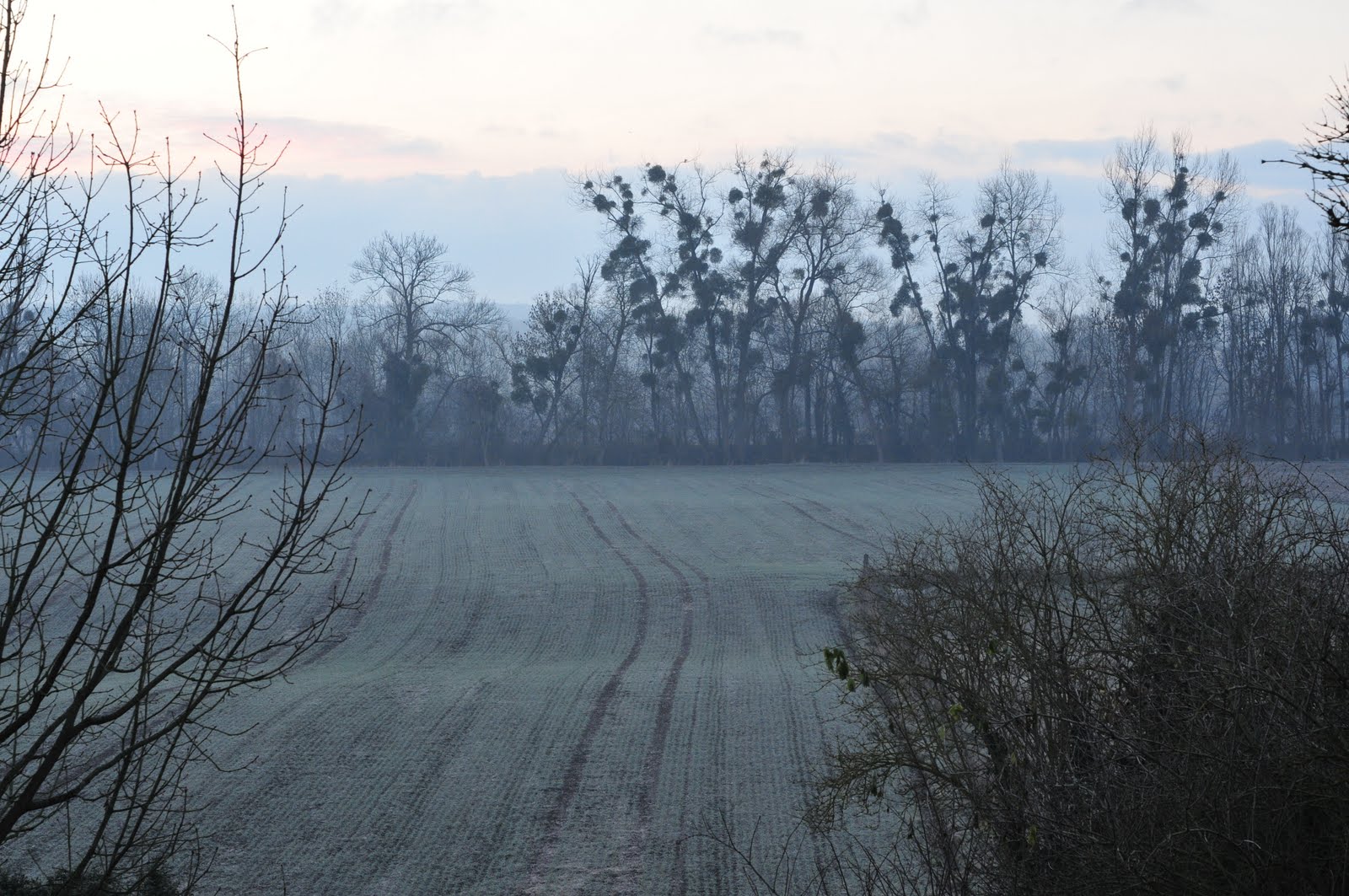
Frost on the fields


I find that the views I take here tend both to the distance and to the very close-up. It's the garden and the view. If they teach things other than how to kill and maybe manage not to kill a plant (they are hard, usually, to kill, especially when you don't want them, but even when you actually do) and how to get lost in thought, they teach you to look and to notice both the large picture of the world that surrounds you and the tiny details of that world.

This is very useful in times of difficulty, when you usually hear Keep your eyes on the big picture every time something goes wrong and your stamina threatens to quit. This is when it is time to notice the very small things and forget all about the big picture for 5 minutes. It's often the smallest things that will get you through and maybe even see your way to whatever goal you are presently cursing yourself for fixing yourself.

Goals are not what they are cracked up to be. You have to be very careful with them or you can get yourself in a lot of trouble, like when someone close to you says, "You take in dogs and cats, why not a child? Don't over rationalize it."

No, do. Do over rationalize it. I implore you.

But, you think You know, you're right. How noble. It's the right thing, really. Just do it. Swelling with all the nobility your breast can contain, suddenly you hear your very own voice saying to that child's other parent, the noncustodial one, "Let's take her."

Rather like that same parent did when our first Labrador Retriever breeder asked back in 2006 if we would take Baccarat's mother, Rapide, too. That time it was he who said, "We'll take her," and he regretted it ever since he pronounced the words into the low September noon sun.

Fateful words, those. Everything changes. You say them, and there is no going back, at least not until you have gone.

I prepared a contract while she prepared her things and he went to get her after work the next day. It was a statement of our parenting intention and how our household works, and a promise to fulfill our obligations to her in return for her promise to uphold our minimum expectations of her.

Her room having been a cross between a war zone and public dump since I have known her, a period nearing one decade, I decided to begin with a spotless room, emptied of all but essentials: books, school supplies, bed, beside lamp, desk, chair, desk lamp, laundry hamper, closet and drawers prepared and waiting. Everything dusted and vacuumed. It was to stay that way. No clothes strewn all over the floor, no tiny scraps of paper adorning every dusty surface, no bowls of Nestle Quick with a spoon burrowed into the back of the desk drawer, barrettes, beads, pen caps, markers, cards, bits of games, pouches, and worn orphan socks and inside-out underpants clogging the underside of the bed, the edge of the woven straw floor covering, collecting dust bunnies larger than her dwarf hamster. In exchange, she would do no heavy cleaning, no unfair share of household chores.

That's my job. That's why I got my degree in architecture.

She would also spend time in the living room and participate in family life, read with us in the evening, do her homework with her father and myself and accept our direction and help, learning to use her brain for reflection and deduction, refrain from using such winning phrases as "Je m'en fiche" (I don't care), "J'en ai marre" (I'm sick of ________), "J'ai pas" (I don't know in slang), "Ba --" (uh or well, as in "well" at the beginning of a feeble explanation), all pronounced in a tone of voice more suited to someone raised in a crack house and not the households of a midwife and a doctor and a cleaning lady with an architect's resume.

In return, she would have more free time in her room for her Nintendo DS and text messaging all her multitude of correspondents, more time at the stables, and the possibility of inviting friends over, as long as the grades are on an upward curve, right along with the attitude.

The first evening went beautifully. We sailed over obstacles that seemed on a level with the sand. By a few days later, as we embarked on a new week, the obstacles looked more like the high jump from our seat on the wide back of a Shetland pony without stirrups. We ran into more than a few, but here's the thing: with children, you are not allowed to give up. You must go on, and they are not anywhere near as cooperative, desirous of pleasing and devoted as your dogs, nor as capable as your cats. There is nothing whatsoever in common between opening your heart to animals and to children.

Nothing.

Dogs may fart and not excuse themselves for making the air temporarily unbreathable (where does the stink go when it goes away?), but they rarely poison the environment with supreme "je m'en foutisme".

Cats may let you know that you are superfluous to them until they decide you are not, but they will rarely let you know you would be welcome to die and go to hell until they need you to prepare another meal.

And yet, their parents love them, and their responsible non-parent steps actually care about them, at least because of their great caring for their spouse, if nothing else, which is not always the case. Sometimes it is because you notice something in the child, something that once you catch a glimpse of it, no matter that it might be fleeting, you cannot forget when they deride your hopes for them, and even those they have for themselves, with their most majestic and taunting insolence.

I dare you to believe in me. I will not. I will show you that you are wrong, and nothing will give me greater pleasure or satisfaction.

Even there, when you look very closely into their eyes, you can see the fear. A question. Panic.

These they wish they could hide, and if you tell them you can see them, if you let them know that you will not give them the conflict they are demanding, that you will not permit them not to back out of the hole they are digging for themselves and correct their behavior, they will tell you Tu n'es pas dans ma tête, and perhaps laugh with deep discomfort because you have visited inside their head and seen the broken furnishings, the scribblings on the wall, the disorder. It does not comfort them to know that you can see and that you will not run. If it does, you will not know this. They will not let you.

It would be best if you simply know and act accordingly.

It takes every ounce of self-mastery to remain calm, repeating the same messages, expressing the same confidence, guiding and commanding without appearing to order, avoiding -- at all cost to oneself -- that drug of dearly beloved conflict, for if anger is but sadness and fear in its most primitive expression, conflict is sadness and fear become active, and finally habit. It's all you can offer and all you can ask.

I suspected when I said "Alright, let's take her" that the peace I had known with her would be replaced with a struggle to the death to create conflict where there had been little to recreate the relationship she had with her mother. It made me soften a bit towards her mother, but not that much. That's another story. It's a novel, or a piece for the theater, for if things had gotten to this, it was not because of a faulty wire in the daughter's head that can be fixed by a psychologist or even better parenting. It is a whole system of poor wiring, created by genes on the one hand and chemicals from responses to the stimuli of a difficult family environment on the other, and it is going to take a team to awaken the unused sensory and intellectual paths to success.

So much easier to stay the paths of non-responsibility, conflict and pain learned by the committed je m'en foutiste, with that maddening angry glare and hysterical grin. But, you have seen something. The moments when it slips because genuine excitement and pleasure have momentarily left no place for anger and self-defense.

This is what you cling to. This is how the details get you to the big picture.

"Regards," I pointed to the kitchen table. My husband's eyes followed my arm and my extended finger to where the SIM card lay on the Nintendo DS. He nodded.

"Elle tient le contrat alors," he said to me, with a slight suggestion that I had accused her of breaking the contract merely by yelling at me that none of her other friends had to have one to live with their fathers.

"Si je te la monte c'est parce que je le sais," I replied.

If I brought his attention to her SIM card lying there in that spot after she had gone up to bed, I told him, it was because I know she is honoring the contract at heart, as best as she can, while fuming about it at the same time. I knew it was a gesture of cooperation, the most important thing we had asked of her other than trust and respect.

I took a bright pink Post-it note from the drawer and a black marker, and I traced the shape of the SIM card on it, placing an arrow pointing to the image of the card below and a smiley face inside. Then, I stuck it to its place on the DS where she had left it and lay the SIM card back down in its little home.

When she came down to find it on the way to school in the morning, she would find recognition and thanks, too. I hoped I would find more strength for another day, clinging to the smallest details.

The struggle itself is enough to make a woman happy.

She hopes and prays.
....