Affichage des articles dont le libellé est Riding. Afficher tous les articles

mercredi 23 octobre 2019

All before the coffee


I was greeted this morning by a tremendous ruckus in the garden. Wings flapped and raucous voices squawked at each other. Fia, who I was letting out to do pipi down in the bottom garden, took off like a shot. I heard wings beat harder and looked in the direction of the noise, somewhere down by the (completely empty!!! Argh!!) pool, and not far from the tulip and birch trees, in time to see a massive feathered body with long, long wings rise nearly vertically into the air and settle on a high branch of the birch. A pheasant. 

I stood stock still and thought about the wonder of a pheasant choosing to visit our garden. 

It is behind walls, along a cultivated field and trees by the Seine. The local hunters release birds, like pheasants, grouse and partridges into these fields to hunt. I have become more familiar with these birds from my long rides with Fibs along the fields and bosquets near where I board him with a grain farmer. Their specialty is taking fright as easily as my Thoroughbred, and suddenly flapping up a storm in the  wheat, the barley or the cornstalks just by his feet, where they go unseen until they lift up in a burst of flapping wings and scare the life out of him. 

It’s always fun.

And, now, here, in my garden, on our enclosed property, a pheasant had just nearly done the same to me. Fia ran about, the usual aviary residents were taking off in all directions, including a second pheasant, also rising nearly vertically to make his escape over the garden wall. I looked back at the one perched in our tree and noted a large nest just above the pheasant, where the turtle doves have been busy without my noticing them. Another sign that I have been neglecting everything that usually occupies me. 

Yesterday, I had a clear sign of that neglect when I opened my box of grooming brushes. It was a mess in the box. I knew the “booboo” cream has leaked all over the toothbrush I use for — I forget what now (see???), but the hair from the end of his tail that I had trimmed and bound with a rubber band was all picked apart. 

I did not do that. I absolutely definitely did not do that. I picked off a bit and threw it into the wet hay at our feet, noting it was kind of less clean and had to have rained hard there. I absent-mindedly opened the little compartment near the tail hair, and there was a nest. It was unmistakably a nest, beautifully rounded, and made of the rest of the tail hair, bits of chewed off plastic (the same color as the surgical gloves in their box I also keep in that box, but I didn’t verify), some white fluff from one of the greys and a little hay.

I felt like shit.

I had been absent long enough for some mammal to locate my grooming box, manage to get into it (how?!?!) and determine that it was the perfect place to nest. As if the damp and pitiful state of the curry glove, the sheepskin glove and the brushes weren’t enough. 


See? I brought it home to clean. 

I looked back at the pheasant and realized that I needed a photo. I ran to the house, Fia in pursuit -- we were going to DO something! No --, grabbed my iPhone, and returned. The branch was empty. 

On my way back inside to return to feeling a bit depressed in the let-down from my months of work on the house plans (waiting is the worst), I stopped to take more photos that I don’t need of a couple bright orange-pinkish red Christopher Marley blooms that had opened, the verbena in the angel hair grass, a bee in the lacey, daisy-like flowers that bloom in the autumn like the lilies in the the fish pond, where I disturbed a frog where he had been sitting in the yellowing reeds and grasses, hearing his plop into the water, and I thought about how smart these pheasants were, to find a place where they could be safe from my neighbors with rifles and a license to kill. I have no problem with that, really. They eat what they shoot, and there is much worse in the world. 


But, when I miss a photo, it bothers me. I needed to find the pheasants. They don’t travel, to my knowledge, based on my intimate, but still pretty limited, observations, very far. Also, I can deduce that in releasing birds, for which you have paid good money, the hunters have a reasonable expectation of finding them nearby when they go out with their rifles. 

I opened the gate, neatly avoided a dog poo (someone lets their dog crap right in front of that gate, and it’s very annoying), and saw the chestnut horse in the pasture look up at me, surprised by my emergence. 

“Hi,” I called out, raising my arm in greeting, as if he couldn't hear me and need help understanding that I was addressing him, “It’s me.”

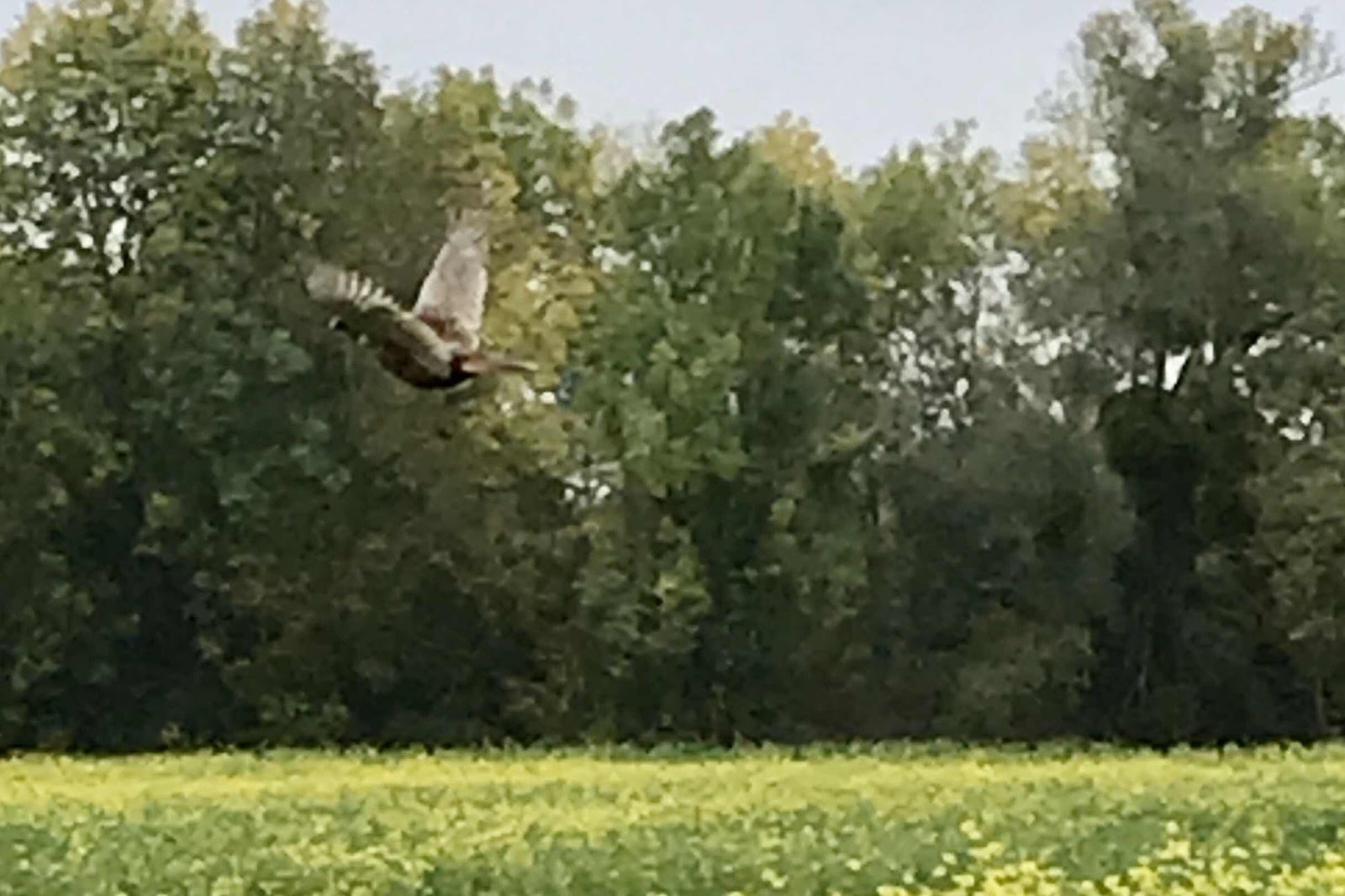
He returned my gaze. Friendly, but not very impressed with me and — there was a slight, very rapid — nervous even? — movement in the grass between us, not far from where I stood. Something was trying to hide. It was a roundish thing, deep chestnut. The pheasant’s head? I trained my phone on it, and BOOM!!! An explosion of feathers and wings and he flew off over the field. I hit the button that is not a button as fast as I could, hoping for one decent photo.

They really are such beautiful birds. I am not even sure they have a reputation as such. Kind of like how I think people think of turkeys. Food. 

Turning back to the gate with my photo of a pheasant in flight over a field of canola flowers, the petite maison caught my eye. 

God, it’s really, really narrow. How can something SO petite be worth the investment of rebuilding?

Those are the forbidden thoughts. It exists. It was useful. It will be rebuilt. 

By the way, I remembered how to ride, and for all his doing nothing, he held himself up pretty well. I hated myself even more when I saw him, with a noticeably reduced top line. He cut his turns on the right reign and needed help, but he was born that way. I’ll do what I can.


I don't know which is worse, the heat pump unit or the embarrassing overgrowth. I can camouflage the heat pump. The stuff never stops growing.  
....

jeudi 31 juillet 2014

The nature of Sisyphus

The felled tree

Sisyphus doesn't grumble. Sisyphus doesn't complain. In fact, Sisyphus rarely speaks. Sisyphus does the job, whatever job -- the job doesn't matter --, and Sisyphus does not give up, ever.

My husband came home from work yesterday evening, and looked down from the stairway to where I stood on the loose dirt of the embankment below the tree, axe poised to take out another bit of flesh. I was alternating between sawing through the trunk with the chain saw and hacking away at its circumference, reducing the size of the saw cut required to get through it, and now I was dealing axe blows. I had heard the motorcycle pull into to the space between the house and the garage, and he had certainly heard the axe head hitting tree.

"Do you want some help?"

I thought about it for a second, looking at him, waiting for my answer. To refuse was, a little oddly, unkind. It was also going a little too far. My elbows and shoulders ached. He was moving down the stairs, closer to me.

"OK."

"But, why are you using the pickaxe, and not the chainsaw?"

"First, it's not a pickaxe, it's an axe." I knew he knew that, but it annoyed me. Everything was annoying me. "And, second, as I have pointed out, the chainsaw is too small to handle most of the jobs for which we need it around here."

"It was good enough for cutting the firewood," he said in his defense, and the rest trailed away, "but it's true we order it cut now."

"What is the harm, when we are buying one of a tool, to buy one that is bigger than we need for most jobs, but can at least do them when we need it for them?" I think he muttered back that he knew. I handed him the axe.

He positioned himself where I had been standing, and prepared to swing. The axe came down once, twice, three times against the trunk, higher by a good 8" from where I had been working to remove the wood. I waited for the silence between the third and the fourth hit.

"Why are you working up there? I was trying to remove a chunk from down there, near the chainsaw cut."

He considered it for a moment, and lowered the axe for the next swing. The axe came down again, once, twice, and he stopped and swore, then gazed up into the branches of the tree, draped in cascades of bindweed and choked to within an inch of its life by thick ropes of ivy. There were, actually, more ivy leaves than elderberry ones up there. I was losing my Sisyphean patience.

I said, as nicely as possible, "Did you come to help, or to complain and look at the tree because that isn't going to bring it down." This is how he works.

Sisyphus was seriously annoyed.

He raised the axe again, and it came down several more times. We changed places, giving each other a break, and then, just before a blow, he stopped and said, "My elbow hurts at the prosthesis."

That was alarming. Several years ago, he had nearly died falling from a high wall, head first, breaking the head of the radius badly shielding his head from the impact. His elbow took it, and the radius had finished several centimeters beyond where the elbow should be.

"Stop, please. Don't do it. It isn't worth it. I can bring this tree down."

"Why don't you wait until Thursday, when we can rent a bigger chainsaw and save you this trouble? We can saw straight through in minutes."

I knew that. I had already thought about that.

"Why Thursday?"

"I am on duty tomorrow night. Wait and we can do it when I am home after."

"I am perfectly capable of renting a larger chainsaw on my own," I said, turning away from where I was preparing to start at the trunk again to face him.

"Yes, but I can help you when it gets dangerous, when it's ready to come down."

This time, I looked up at the tangle of ivy and bindweed over my head, and turned back to him.

"I have brought trees this big down here before, several of them. I can do this one, too."

I did not say that I could not stand the idea of waiting. Why? I could do other things. I knew it. I looked down the length of the light guage chain-link fencing on top of the embankment, sagging under the weight of the ivy using its posts for shoulders upon which to sit and sprout magnificent balls of shiny dark green leaves, like heads with bouncy green afros, which I had already trimmed. They annoyed me, too.

Add caption
I could return to cutting the ivy out from the chain-link behind the posts, and snipping away the inside layer of rusted chain-link. I could very well do that and rent a chainsaw to bring the tree down Thursday. This was a perfectly reasonable proposition and alternative.

"No."

Sisyphus had just spoken, and we both looked a little surprised.

"It's alright. I can do this."

I must have stopped soon after. It was getting late. I was tired. There was dinner to make, and I had just admitted that nothing could stop me, not even perfect reason. I am rational enough to understand reason, even to reason, but something stronger takes over. A glimmer of new penetration and understanding caught my eye from between the comingled leaves of ivy and elderberry.

I had all the following day to reflect on that. In fact, I had as much time as it would take me to bring this tree down. I looked back at the trunk after my husband began the climb up the stairs to the house, and tried to estimate just how much time. There was progress. At least half the trunk was removed. I looked at my tools -- an axe, a sledgehammer and wedge, and a puny chainsaw --, and my resolution set. I have a tempered will, but why? Why had I never stopped to wonder why, or even if it was really such a thing about which to crow? It was not entirely true that Sisyphus does not complain. Sisyphus does a lot of that, actually. No, not while she is doing the job, whatever job, the job doesn't matter, but after, when she feels undervalued, then Sisyphus delivers speeches containing strings of charges and complaints.

The axe fell again and again, and the chainsaw screamed and smoked its way deeper and deeper into the flesh of the tree, and Sisyphus considered why. She scrutinized her progress with the tools at her disposition, the only ones of which she would avail herself, like a settler, a woman bound to survive and make a life, even, and planned her way through that trunk. She looked up at the leaves not to breathe, but to consider the angle of the trunk, the mass of the higher, nearly vertical branches, the location of the neighbor's chicken abadoned chicken coop, a tile-roofed masonry structure, solid, but not something she cared to demolish for him, bringing down the tree that diminished both of their pleasures in their properties, and calculate which way it would most likely fall because fall it certainly would. Failure, for Sisyphus, is not an option, and failure to fell this tree was out of the question. It was coming down, and it was coming down as soon as physically possible.

But, still, she considered why. Why did it matter so much? Why had it all -- all of these gigantic, absurd, time-consuming and repeated projects -- mattered so much? Sysphisus thought she knew. It took only to see the question, and wonder why she had been unwilling to ask.

This was not the same tempered will and determination that saw her and Fibs out on the trails, galloping across the field, listening to the rhythmic snort of his breathing you only hear at a gallop, and that she had only heard on the piste jaune at Maisons-Laffitte, the racetrack, or from the horses in the highest level show jumping events, heard her horse just below her body breathe this way, carrying her on a journey and in the delight of movement, even though they were related. No, this was something else altogether. Perhaps, though, she considered, it took that other determination to hint at the difference and give rise to the reflection that brought with it the realisation that she had been fighting a battle, not against nature, not for the glory of the victories she counted as hers, even if they later proved less worthwhile and satisfying than she had imagined, and created a lot more work for Sisyphus along the way.

Sisyphus, it happened, was not happy. The work, the jobs she executed, whatever job -- the job didn't matter --, was an expression of her tempered will in opposition to every other force in her life. It started as something to do: resurrect a tangled, lost garden and make it beautiful; but, it had become a struggle, a fight. It was supposed to redeem the garden and herself;  it had became her weapon, her means of punishment for everything else, and a shield all at once.

The too small chainsaw weighed a ton. Her arms ached. And then it's teeth caught flesh, and it moved, screaming, but without smoke, through the last bit of fiber. It was almost done. She inserted the wedge and considered the weight of the sledgehammer. It wasn't for much longer. After the blows, she listened for the cracking, racing backwards to get away from the trunk in case that last groan was the end before it fell.

She sent a message on Facebook, "I feel kind of badly."

"Why?"

"It was a living thing."

"It will be alright."

"The tree or I?"

"LOL. You."

She took a photo of the tree trunk, now sitting on the wedge instead of the lower part of its now severed self. The wedge knocked out, a long electrical cord tossed up into the crotch of a branch and the trunk, and a game of tug-of-war later, rocking the tree forward and back, the trunk slid off its perch, and the tree fell back. Not forward. Back.

Sisyphus muttered, "Shit."

She thought she would feel triumphant. She only felt depressed.
....


jeudi 10 octobre 2013

A place to start

Fibs finds freedom, September 3, 2012

For some reason, the veins standing out against the muscle on his hindquarters and legs, just under the deep copper coat, like tracery in Gothic church windows, make me think about his story and about how destiny works, and whether it exists. He was foaled in North Yorkshire, pretrained in North Yorkshire, and lived the first few years there, as well, before going to Newmarket, to Maisons-Laffitte and finally to "la boucle". He raced, and then he stopped racing. He knew people, and they knew him, but how well? Had he friends? Did he miss anyone, and did they miss him?

"He's grumpy," I was told, the implication was that others were not, or were less so, and possibly better prospects, but I was not prospecting. My name was already on his certificate of ownership. I was his owner. If I weren't, I wouldn't be propsecting.

Or, I would have been, since I wouldn't yet have learned my lesson, that I am decidedly not remotely close to prepared to be a race horse owner. Sadly. I would like to have the sort of disposable income that makes risk fun, exhilarating, and be able to take the losses and the setbacks in stride. Really. Fibs taught me that I do not by teaching me what racing is. Had it not been he who taught me that, it would nearly certainly have been another horse in his place, and the story would have been the story of me and another horse who was not Fibs, a less grumpy horse, perhaps.

In ordinary life, the one I led right up until I heard about Fibs and Flannel and thought breaking even was the worst that could happen to a hapless and unfortunate owner of a single race horse -- I apparently have an amazing ability to hear what suits me and a frightening lack of imagination, which was a surprise to me and has led me to consider the difference between concepts like "spontaneity", "romance", "determination", and "risky" --, I was not looking for a horse. I have a husband, who works, and a child and stepchildren, and we are the sort of people who do not have Great Means, and who see to their children before themselves. In that life, my stepdaughter was riding, at my behest and with my encouragement, and I was not. When she was 12, I took her to the big sports clothing and equipment store and purchased the essentials after her trial lesson at the pony club: helmet, boots, chaps, breeches, and a crop. She was ready to mount. One day, she brought a crop to the house for me.

"Tiens. Maintenant peut-être tu monteras avec moi," she said. Here, perhaps now you will ride with me.

"Ah, c'est gentil, mais non, ce n'est pas pour moi." It is not for me.

The crop sat in a corner, next to the backgammon and chess cases that had travelled from the States, getting a headstart on the thick accumulation of dust the crop would eventually attain. I dust too infrequently.

To be truthful, it was not for me, either, that we had wound up in a trainer's yard in Maisons-Laffitte. First lessons had led to three or four "galops" (like the snowflakes in ski lessons) acquired, and we had also become acquainted with the pricetag of a taste for riding and ambition in it along the way, and I was looking for ways people who cannot afford quite a number of thousands of euros a year can satisfy the desire to ride, bigger, better, faster.

I had noticed that my stepdaughter always smiled in competition and that speed did not seem to alarm her, and reading the racing blog in the New York Times around the Breeders' Cup, nearly two years ago, I came across the story of an American journalist in Paris, who had given up reporting to train race horses full time, Gina Rarick. I went to her website, read about the horses available, including a share in Satwa Sunrise, clicked on the links for the training center in Maisons-Laffitte and watched the France Galop video describing its wonders. The little girl who remembered the Walter Farley books joined me and imagined Alec and Henry and the great Black Stallion and Flame on those exercise tracks in the early morning Parisian mist.

I opened my email, typed a message of introduction and asked if we could visit. I had a young teenage girl who might find a future as a stable slave and exercise rider there.

Two weeks later, the answer came. In true Gina style, it was brief, cheerful and frank, "Sure!"

Instead, it was the little girl who had read The Black Stallion, and every other book about horses she could find, who found her future there, and the husband of her older self who would learn who he had married. I was an architect. A woman who earned her living and keep, from the earliest time in her life, who had provided for her son, and knew what $5 had to buy all the way through college, and who didn't forget later in life. Now, from considering a leg or two in Satwa Sunrise, to having two in Elbow Beach, 6 months later, I owned Fibs and Flannel, and another 4 months later, he was stepping off a van and into my immediate life. Cinderella had found her Prince Charming, and the Wellies he brought fit. Perfectly. He wasn't black, either, like my literary dream stallion; he was red, like Flame, his arch enemy, and he was a gelding. At least that much.

And, he was "grumpy".

So was my husband. And so, I would learn, and already suspected, would we all be. The wrong person in this story had the horse.

Also, he was a little skinny. Nothing some groceries and a little Phosphalugel to protect his tummy couldn't remedy.

I was learning already. The initiation begun at Gina's, where I listened to every word uttered by her, by her assistant, Agata, and by the vet, Jérôme, had just shifted gears. This concerned the horse in my direct care, boarded near my home. The vet was on the other end of the phone line with the owners of this private owners' stable, listening and asking questions. Fibs would need the Phosphalugel for a week, two would be good, unlimited access to hay, and a gradual increase in the grains as he adjusted to being fed regularly again and put weight back on. By my friend's eye, he had lost some 35kg in the 3 or 4 weeks since he had last raced in late July. I took the paper held out to me and headed off to the pharmacy for the bottle of thick, white liquid he, my horse, would be ingesting morning and evening to coat his tummy and protect against colic and ulcers.

I was full of hope, and a little worried: not about my horse, but about how we were going to work out everything around this horse, and what his presence in our lives meant. A former race horse  in a stable is, I suspected (rightly), a lot like an elephant in the room, the one everyone is avoiding discussing. Yes, that one. I suspected that we weren't all on the same page, because we had never been, because we were a "recomposed family" of ill-fitting and missing pieces in a difficult environment, and because just getting a dog a few years before had been "challenging" and nearly led us to divorce court, exposing the insecurities of certain ones with respect to the goodwill of others.

This would be the beginning of trying to hope, while taking things day by day and suspecting that things could go all wrong, beacuse of all the things left imagined and unsaid; of seeing and hearing without knowing what it all meant and why; of taking delight, while not feeling free to do so; for the simple fact reigned and governed everything: the wrong person had the horse.

If the garden had been the place where I could take refuge and reflect, make things happen and find some satisfaction and a little solace in the life and the stepfamily we had undertaken, my consolation prize for the professional life I had left behind, the horse would be the thing that cleaved and laid the bones of our situation bare.

This, I knew, is also a place to start. His story before, I also knew, was going to be nothing next to mine from here on out.
....
It's just a jump to the left


dimanche 27 novembre 2011

Sunrise


Satwa Sunrise

It's cold in late November at sunrise in Maisons-Laffitte. Almost as cold as sunrise in Argentière in January or February. Vapor billows around the horses nostrils and heads and off their flanks after their workout, and the low, golden sunlight makes it visible.

The work begins before first light and finishes at the lunch table, at home or at Le Pur Sang, full well before 1 pm, when a full work day is over. With 80-something lunches served before the hour was out, I missed the Lemon Ricotta Cheese Cake.

Oh well. I'll just have to go back.

This was our second week driving down the highway towards Paris, through Poissy and Maisons-Laffitte in the last dark of the night. I love getting up early with a purpose, being among the early risers, the first up and out. When we arrive, the rectangles of light from the box windows tell us we are not the first. We know we won't be, since we arrive at 7:30 am, an hour or a half hour after the lights are first turned on and the boxes opened. Curious heads poke out to see who has arrived. Vlad, the stable lab, trots over to say hello, and friendly voices add their own.

The horses have already gotten their first bags of hay, and Gina and Agatha are saddling up the first two to go out for their exercise. There are boxes to do, leather to be waxed, corners to be swept and mouse traps to be reset after I accidentally spring them with my broom, one after another, like popcorn popping. They all come up empty. Vlad has been efficient, but the evidence of their past presence is clear from the neat, round holes in the good wool blankets.

I pitch some soiled straw from the cleaned out boxes out behind the stables, and a small form darts into a hall in a particularly urine saturated pile that seems not to have been touched by the truck that comes to haul the old straw bedding away. A mouse. Gina tells me all the holes in the concrete block walls of the pit are mouse nests. I thought they were birds. Let the mice stay here, far from the good English wool saddle blankets and covers.

I think I am the only one who likes the dark, and the chance to watch the sunrise through the thickening morning fog and the horses' breath. Gina counts the days until December 21, and I tell myself Wait. Perhaps the charms are so many more once it is full light at the start of he work day in the racing stables.

Or, perhaps this charm wears off quickly.

Today, we saw Really Hurley and his jockey again. His jockey remembers us. He likes the camera, and I take more pictures and look up his racing performance when I have a moment the next day. I have some doubts about his being a crack, exactly. I recognize that I still need to ask everyone else's opinion on the matter. He is 6 already, although I have read that Steeplechase, or National Hunt in England and Ireland, horses are geldings and retire at an older age, so perhaps his best is to come. Really Hurley has run 36 races, with 3 victories and 9 places. In Quinté+, where the first five horses place, he has run 10, won 1 and placed 4 times. That actually gives him a pretty decent overall performance, winning or placing in a third of his races, and in half of the Quinté+ in which he has run.

I am starting to want better camera equipment. I had better find a winner to back, like Sunrise.


....


mercredi 23 novembre 2011

Gina Rarick's yard at Maisons-Laffitte

Satwa Sunrise and her neighbors


Ever since I was a child, I have been crazy for horses. Like every other kid, I read all the books, Misty of Chincoteague, and everything else by Marguerite Henry, Black Beauty, My Friend Flicka by Mary O'Hara, and dreamed she was my friend, and The Black Stallion series by Walter Farley. It was Alec and Henry and their black stallion who captured my imagination more than any of them. I lived the races with them, and I dreamed of the racecourses down which the black stallion beat out his winning rhythm.

My grandparents lived outside a small city on the Saint Lawrence River in far northern New York State. Up the road were two farms. One in which my uncle stacked hay in the hayloft; the other more majestic. It was just  a little farther up the road and on the other side. The Carlisle's farm. They had horses, paddocks and a ring. My  uncle put a cushion on the crossbar of his red Schwinn bicycle and rode me up to the farm to play in the hay and maybe help me a little, but it was the Carlisle's farm of which I dreamed. We rarely went there.

I remember once, and I don't know how or why, being there with our mother with my sister. We each got to get up on a horse, our first time. I couldn't have been older than 8, my sister 5. I sat on that horse, facing the horse barn, and my mother said, "It's your sister who is a natural, not you." I was stung, but I did not want anyone to know. I don't remember anyone else being there to hear her words or to see my disappointment, but someone must have been holding the lead. That, or it was the gentlest, tamest old horse in the barn.

I supposed it was fair. I loved skiing and waited all the warmer months for the snow to fall, going down to the basement to look at all the ski equipment hanging from and leaning against the concrete block walls. My sister didn't. If she hadn't already, she would soon go out one morning, a blizzard blowing freezing air and heavy snow across the region, the Lake Effect, God love it, and declare to our father, "No. I am not going to ski," and she didn't. She turned around and went back into the lodge, where we found her for lunch. That was her last time to the slopes with us. So, perhaps it was fair that horseback riding was for her, but neither of us got to do any of it, anyway. It was inaccessibly far and expensive, and we each relegated horses to our dreams and met them in our books.

It was a couple years ago, when my stepdaughter was going through a first rough patch, that I asked her if she wanted to ride. Her eyes grew three sizes and her whole face opened in excitement. She nodded yes.

"Mais, Papa ne voudra pas."

"On s'en fou. Tu me laisse gérer Papa. Je veux bien pour toi."


Papa won't want me to ride. 


We don't care a fig about that. Let me take care of Papa. I want that for you. 


Her first session, that July 2009, she was timid, reserved, and absolutely delighted. They learned basic care of the ponies and led them to the paddock. Mounted them, and learned to sit, to hold the reins, to start and stop. To try to change direction. I had no idea where we were going and whether she wouldn't finally decide it wasn't for her; whether she wasn't too timid, afraid, finally. Several months later, during the winter, she had her first galop of the 9, like your first star in skiing, and Julie, the director of the pony club, told me very simply that she was gifted. her father was more restrained.

"On verra."

"Mais tu ne l'as pas vu monter et Julie a vu passer des tas d'enfants; quel serait son intérêt de dire une telle chose si ce n'était pas vrai?"

We'll see.


But you haven't seen her ride and Julie has seen tons of kids; what would be her interest in saying something like that if it were not true? 

Still, he demurred, and his daughter continued to pass her galops "au galop". The second, the third, the first part of the fourth last winter, a year and a half after she had first gotton on Frimeur's sturdy back. She as jumping, and she had competed in her first unofficial competitions without ever losing a huge smile on her face. Jumps, speed, nothing made her afraid. It delighted her. I brought her father to see Julie with me, and she told him, "Votre fille est douée."

Your daughter is gifted.

The French respect what they consider expert opinion, even if we were not seated in front of the director of the national team. At this level, it was enough. He started to come to see her jump, and he realized: she rides beautifully, with grace, composure, assurance and joy.

If I were never going to ride, she would ride as far as her talent and ambition, and our means, stretched, could take her. Not that she didn't want me to ride; when she started, she offered me a crop. It sits at the bottom of the stairs, with the unused backgammon set, a box of bills and my stable boots. I got those a long time ago for walking the dogs, working outdoors and general wearing when I don't particularly care about my elegance, or most of the time. I have made progress, though. I now where Ugg boots for that.

Two weeks ago, Julie scheduled her to finish her galop 4. It was way past time, and not liking dressage is not reason not to pass it, and a little before then, just before the Breeder's Cup, I saw the New York Times was starting their blog, The Rail, again and looked it over, including the contributors. Imagine my surprise when I learn that one of them is a woman, a professional thoroughbred racehorse trainer at the Maisons-Laffitte international training center, just outside Paris, and that she is from the United States. Her name is Gina Rarick, and I sent her an email through her blog on her site, GallopFrance.com, and, she replied. We were welcome to come to visit her and the yard, and, better still, she had had a number of girls my stepdaughter's age work with them and it had always worked out beautifully.

We went to see Gina and the horses and everyone who works with her last Saturday morning, but that's another story, for another post.

Meanwhile, I have been back to help muck out the boxes, clean up the hay and straw storage rooms for a delivery -- I got rid of as much cough and respiratory problem-inducing dust as was humanly possible; horses are meant to run, not stay home with a cough --, and feed and give water to these gorgeous creatures: Satwa Sunrise ("Sunrise"), Magical Flower ("Magic"), King Driver ("King"), Deep Ocean, Triple Tonic, Hard Boy and Surrey Storm ("Milly"). And I acquitted myself decently.

My stepdaughter will be returning every Saturday morning to help out, and eventually to exercise the horses, if she is ready. I am in training for the 5:30 am weekly Saturday morning alarm, in addition to the ones that will ring Sundays for competitions.

Right now, I need to hurry up and get ready to meet Gina over near the highway to Horse Breeding land, Normandy. We're going to the farm where she rests her horses to meet a young woman coming to take one she had to retire and is giving away in exchange for a good home for her.

As for me, I might not ride, but, who knows, perhaps I will invest in a share in a thoroughbred.
....