Affichage des articles dont le libellé est Pruning. Afficher tous les articles

vendredi 9 mars 2012

First frog, and a foal for Zenyatta

First frog of the spring

The sun lit the slats in the metal shutters of my bedroom window with the brightness and intensity that announces a beautiful morning, encouragement to get out of bed, in spite of the aches and the pains from yesterday's labors in the garden. It has been 3 years since the last time I pruned the linden trees down to the ham-fisted main branches, and so it was time to do them again, lest the linden trees overtake us and leave us in the dark. I did one in the morning, and the other in the afternoon, going up and down my wooden ladder and wielding a 3-ton 45-inch chainsaw at arm's length.

I now have two very large stacks of 3 to 4 meter long branches of which to dispose, and I need to find someone who can come and feed them into a wood chipper for a modest fee.

Come summer, there will be a whole new crop of wand-like branches growing from the bumps at the end of each solid branch, sending forth a dense canopy of large leaves.

Taking note of my bruised state, little didn't hurt, I rolled gingerly out of bed and made my way, stiffly, to the coffee machine, but the lure of the warm March sunshine was too strong, and I got the fish food instead and headed out to feed the fish and see how nature had been faring since my first exploration and photography session earlier this week, after I had lifted finally the soggy mat of linden leaves off the planting beds, prying them gently from the fresh green spears of the new tulip and hyacinth leaves to expose everything that the warming soil was sending up for another round of the eternal display of nature's simple glory. 


These are the days when you can feel the activity in the soil and the leaves, the energy unfurling progressively more vegetable matter, the chloroform machine working at full tilt, catching the sun's rays and radiating the purest, most joyful green from the effort. I hum right along with the plants and the blades of grass of my garden and all of nature beyond; I began my day brimming with energy and enthusiasm. 

I bent down and called the fish over for breakfast, waiting for the one large female I know is principally responsible for the healthy growth in population since the devastation wreaked by some cracks in the converted fountain's low walls and a sudden, terrible freeze one January, when the water level was too low killed dozens of fish, leaving 4 miraculous survivors. 

She eats first, and she and everyone else know it. She swims right up to my outstretched pinched thumb and forefinger, a koi stick presented to her, and we struggle to get it in her puckering mouth. Some mornings we get it on the first try;  other times, she's either too hungry or too overexcited to get it on anything like the first try, and we nearly give up, but that would be sending a poor message, and so I never admit defeat. She will get it or no one will eat, which is out of the question. 

This morning she was a little late arriving, and my attention drifted off to the others, swimming about in front of me, others heading across from under the old stone sink where they have their hide-away, and which has served as the favorite spot for the frogs, who have come to make the fountain-turned-fish pond their home. She caught me by surprise, suddenly there in front of me when I lowered my gaze again, and ate her koi stick on the third try. I turned the container, sprinkled a generous serving for everyone else, and watched it float out from the center. I love the "fish pond". 

Yesterday, a neighbor's little girls discovered it; I told them there were frogs, too, but they were still asleep, down in the sediment from the decomposed leaves that fall into it and the aquatic plants. They asked when the frogs would wake up, and I said soon. Perhaps in a couple more weeks of this warm early spring sun. They are not like the other neighbor's children, little boys, who run around the fountain and stick their arms in, pulling on the plants. They nodded and returned to watching the fish swim about, and I had a feeling that soon was maybe sooner than I had said; it was the right weather for the frogs to wake up.

Squatting next to the fish breakfast party, I saw movement over near the mossy edge of the stone sink. It didn't move like a fish; the plant leaves disappeared below the water and surfaced again along with the head and large, globular eyes of the first frog of the spring. As if the day did not promise enough wonderful things, with the aubrietta in flower on the tall wall behind the gazebo, the transcandentia sending up its first purple-edge leaf swords, and both the biathlon and the nordic-combined world championships on television, the frogs had woken up.

I said hello, quietly, and asked it please not to move while I went for my camera. They take fright easily, some eventually learning to relax around us, others never failing to dive into the water directly I or anyone passes by them. He, or she, granted my wish, for a moment. In another second, he had ducked back into his watery place to hide, and I went off to see what was sprouting in the garden.


Now, it was time for my coffee and my morning email, Twitter and Facebook correspondence, and to upload my photos and consider a blog post. My old laptop takes its sweet time to boot, time to check the day's events on Eurosport, and when the first Tweets scrolled past, there was news of Zenyatta. She had given birth! A dark-bay colt, the spitting image of his lovely mother. 

As if the day needed another miracle to remind me of how beautiful life is. Sweet, intelligent and wondrously gifted and large-spirited Zenyatta, The Queen, had given birth to her foal with Bernardini, just hours ahead of her due date, under a full Kentucky moon, and her fans were rejoicing a new hope, another racing phenomenon to love and admire and cheer on, born of the intermingling of proud parents' proven genes. 

For now, it was quiet in her box, a mother kissing her long-legged, gangly, adorable newborn child, full of the promise of his family history, everyone who loves and cares for her daily at Lane's End Farm nearby to witness another legend opening its next chapter, and the season of foaling beginning with the greening and unfurling of the grasses.
....

http://www.zenyatta.com/diary/diary-post-454

dimanche 20 mars 2011

Garden dog

Fia's sticks


Fia gardens, too. There's nothing I do that Fia can't do, too. Almost nothing; she doesn't drive, for example, and she waits patiently for me to feed her, rather than tearing into the very accessible pet food bags.

Good dog, Fia. Good dog.

She watches me for long stretches of time, stretched out in the shade of whatever tree, shrub or structure is available -- a recent discovery is the unwanted and unfortunate hollow under the big rhododendron I planted a few years back; at least is has a use, even if it represents a failure to plan for settling correctly --, and she learns what gardening involves and decides what parts of it are appropriate for her. It will not be surprising to anyone who knows and loves Labrador Retrievers that with all the pruning I have been doing this month, she had found her use: stick retrieval.

There were piles and piles of sticks that she watched me carry laboriously down to the burning pile, and she considered this. Sticks. Carrying. Sticks... carrying...

"I can do that!"

She didn't say it. I heard her think it.

And then I saw the consequence of her realization: sticks everywhere. Garden Dog was picking up the sticks out of my piles as a dog can, in her mouth, and carrying them up to the top terrace lawn, while I went on with my Edward Scissorhands imitation, cutting, cutting, cutting and making ever bigger piles of sticks that Fia busily diminished according to her abilities.

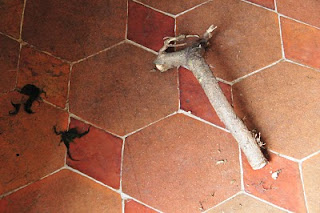
Naturally, given what one Labrador Retriever can carry in her mouth, I didn't notice until I staggered up the stairs to get a glass of water and found sticks littering the lawn, all the way from the stop of the stairs, along by the fish-pond-in-the-old-fountain, on to the steps to the French door and then strewn around the terracotta tile floor. Some were shredded, like McDonald's lettuce, only with more fiber.

Rapide's bed is full of shredded sticks at all times. Like having potato chip crumbs in your bed.

Thanks for the hand, Fia.
....

vendredi 18 mars 2011

Taking a rain day, or March Misery

The Wood Pigeons in their Tulip Tree


After a long and difficult day on the couch, writing, organizing photos in my laptop, and preparing for Couch by Couch West (enjoy Neko Case and Liza Case), I decided it was time to go out and take relief in the garden, maybe sawing out the rest of the overgrown ivy climbing the garden wall up into the neighbors' neglected fig tree, or maybe raking the bottom garden lawn and burning some more stuff before the rain begin, for it will begin. I have learned in 9 springs in my garden that March is the dry month, making it the perfect month to do the garden clean-up and pruning and burn the cuttings.

Of course, if we are allowed to burn stuff in our gardens, it is because it is generally assumed that this is still the wet time at the end of the winter, so it is generally safe to burn stuff until May, when it begins to rain, and it gets dangerous, but it is supposed to be dry and warm by then, so --

Never mind.

The month -- and I am making an allowance for February 28 by counting it in the month of March for literary purposes -- began with a severe pruning of the two yews, my "sentinel" yews, at the top of the stairs down into the garden. Start, I figured, with what you see every time you leave the house, and that of what your husband complains most.

Ah. Peace and quiet, and thanks. Gratitude is lovely.

The next day, March came in like a lion's maw in my garden, and it's not over yet. No wind, but a whirlwind of pruning and burning. Almost every day, the burning pile reformed and then disappeared in a conflagration, smoke, flames, ashes and sparks jumping into the air. I have ruined one fleece top I have worn for skiing and everything else for 13 years, and one of my husband's favorite organic cotton, long-sleeved shirts I was wearing underneath. They have identical perfectly round holes in exactly the same place on the right upper arm. Now I know why it's important to make clothing anti-inflammable.

I attacked the whatever that tree is down by the gazebo. The one that looked like a Blow-pop pruned, the head of which was leaning over the Rose of Sharon along the bottom garden wall after the weight of snow it carried in December.


I was not sad to see it go.

That was followed in the same afternoon by the gigantic yew just below that had also been damaged by the heavy snow of December. Heavy for Moosesucks.


We were especially not sad to see it begin to disappear.

Aching and feeling my carpal tunnel making its return, hands sound asleep long after I awoke in the mornings, I went after the second terrace plants and shrubs -- the Vanhoutten Spirea that looked like Animal, the Fuchsia magellanica, lavender and the lush and abundant moss in the sparse grass. Slender branches. Easy prey.


There won't be many -- or even any -- sprays of tiny white flowers on the spirea, but that's the way it goes. I'll prune it in November this year.

Then what? Oh, in between the Vanhoutten Spirea and the last of the lavender and fuchsia, I cut down the several meter high trunks of what was supposed to be a Snowball Viburnum bush. Bushes are not several meters high in my book. I call those "trees". This one had lost it years ago, and all that grows now are suckers and these trunks.


This was the first step in destroying its stump and getting rid of it altogether as part of the clearing of the bank and these plants, as well as the hedge across from it, to make place for some sort of shelter for the motorcycles, the old wood boat behind the low cinder block walls, and garden shed. Dream on. I can't even seem to manage to finish the inside of the house.

I am hearing about that from my husband. Trust me. It isn't as easy as pruning down the sentinel yews.

Partially recovered, anyway, I attacked the next big horrible project -- clearing out the top of the high wall behind the barbecue on the gazebo terrace. The last time I did this was 2005. It was, if that is possible, worse then. But back then, it probably hadn't been done since the barbecue was built in 1991. This took two days, March 10 and March 16.


I am still recovering from the bug bites (fleas, I think) and the thorn pricks from the Firethorn shrubs, with their poisonous (for me) several centimeter long thorns on each and every unyielding branch. If Hell has hedges, they are certainly made of Firethorn shrubs.

Between the two skirmishes of the Battle of the Top of The Wall on the 10th and the 16th, I did something. I know I did. Let's see -- yes, I took a little vacation and hand pruned the Saint John's Wort down to the ground.


So, where did I start this? Yes, I got up off the couch to go out and continue, and what did I see, other than the pair of Wood Pigeons in their Tulip Tree? Rain. Rain falling in the fish-pond-in-the-old-fountain. Rain falling into the shocking pink and deep blue hyacinths.

Rain.

I felt relief.

I have pruning elbow from all of this. I think I'll watch the quarter-finals at Indian Wells.
....

lundi 28 février 2011

Boughcuts do not hurt

The mess


It is still the forenoon, and I have finished the yews.

I have not cleaned up. There is the Nordic Combined team competition. I have my priorities straight.

Last evening, I lopped off (makes it sound so easy; it's not) a meter in height. This morning, I got up, took the dogs and the trash out, made my coffee and gritted my teeth. I was determined to be useful (or yewsful) and headed down to the far edge of the middle terrace to check out the growth on the 'Daniel Deronda' clematis I thought I killed last August, but which I discovered to have been sprouting discreet leaf buds amidst the overgrown ivy and the blades of the daylilies, and it occurred to me to see what the yews looked like from below. Would they be better shorter from that perspective? Fia sat her butt down in the St. John's Wort bank behind the little hedge of box to watch me watch.

"Fia. Sors de là."

I don't need to yell. I don't need to get excited. I just need to tell her, You are not welcome to sit in my St. John's Wort. No, not even if it isn't high season yet. She hopped over the box and sat her butt down next to me, and then she watched vaguely for whatever it was I was watching.

Shorter. It could definitely be shorter by a good 60 cm.

Besides, when you realize how tall they had grown, you understand that the branches are very thick right up to the top of the bush. It's actually better to take them down farther, as well as to remove large branches near the perimeter, than you might actually want them so that you can let slender, new growth push upwards and outwards. It makes future pruning, if you actually do it regularly, much easier.

Fia followed me back up through the fallen wisteria leaves and the yew boughs covering the steps, and I went to work.

It was hard-going. For the fattest of the boughs, I had to wedge one long handle against my rib cage and use both hands to pull the other handle, and that balanced on my ladder. I don't bother fearing injury. I'll deal with it when it happens. It would be a lot easier if I got my tools sharpened, though. One more item on my "to do" list to infinity and beyond. Bough after bough landed on the cutting pile, and up and down the ladder I went, checking out my progress. Fia sat and watched. She didn't even race around the fish-pond-in-a-fountain with the semi-shredded plastic nursery pots she had left littered about the terrace.

She is becoming a fine garden dog.

The last tall bough down, I went and got the electric hedge trimmer and ran it up and down the sides of the yews. One had grown far portlier than the other. I took the pruning shears and removed some of the largest boughs at the edge of the left yew.

Then, Fia and I headed back down to the daylily bed and the 'Daniel Deronda' to take another look back up.

It would do. It's a little bare for now, but new little shoots will push their way out and green it up soon.

After lunch, clean-up time. And despite the damp, I might try to make a burning fire.

If I don't clean up, my husband will step right into the boughs on the steps in the dark, fall and break his neck heading up from his motorcycle. I will hear, PU-tain! And then he won't love what I did so much.

....


dimanche 27 février 2011

Starting again

A Japanese Maple in bud


It was three weeks ago that I took my camera out into the garden to find spring. It was there. Early, but there it was, in the first leaf shoots of the clematis (which reminds me that I have to go out and cut a bunch of them and the honeysuckle down to 30 cm from the ground or get no flowers again this year), the first buds on the grape vines I still haven't planted after nearly 6 years, on the Hortensia that barely survives summer after summer since I put it in 3 years ago down behind the pool and the maples I stuck in the same planting bed, waiting for inspiration to hit me, and the chives sending new blades up, the Bergenia cordifolias' bubble gum pink flowers opening, and the usual appearance of the first crocus and furls of tulip leaves on their masts.


It has been a clement winter since all the snow and cold of December. People returning from their annual ski weeks were grateful that there was still December snow on which to ski, and I have been longing for it to do its job here, which is to hide the ugliness of the garden out of season. I have had no such luck this year, and to make matters worse, I have had a perfectly well-behaved 6-month-old Labrador Retriever, who is a terror out of doors, racing flat-out around the top terrace and after anything that resembles an empty plastic nursery pot, a bedraggled unplanted clematis, or a stick or bit of wood of any description or origin. The yard is strewn with bits of clematis root, bark, and shredded plastic nursery pots in black, dark green, and terracotta.

Did I mention the piles of pooh?

Add the leaves that fell with the last snow that I never raked, the moss invading the grass, and the generally sodden appearance of everything from the nonstop drizzle, and it's an understatement to say that it looks like hell out there, but, today, the sun came out, and I got my camera again. Where I have crossed the top terrace, heading down to the bottom garden for wood for the wood stove or from the gate to the front door or the front door to the dryer and
fridge in the garage, my eyes averted, I went and looked again. I found things to make my heart soar, and things to make me very sad.

One is the weeping rose I tried to save. It is dead and gone. Rotted from the inside out. I don't know what hit it. For years, it was unstoppable in its pageant of magnificence, even giving us a second burst of bunches of tiny pink roses again in late summer, but last summer, it sent up a virtual bouquet of suckers. I would just like you to know that I have never killed a rose bush. Ever. I have looked and looked, and I haven't found quite what happened to its bark. It has to be a sort of blight, a mildew on the trunk itself. It will be hell to dig it up. The lavender plants at its base will have to come out, and then it will be a major undertaking to dig out its tap root to plant another in its place. I had to do this once years ago, when I first began working in the garden. The twin weeping rose over on the other side of the second terrace had died, and my first birthday gift to my husband was a new one, and all the work that went into renovating the lavender and planting it.

My camera battery died just as I noticed the new leaves uncurling themselves on the peony that lives under the spirea bush I never finished pruning. A little late, now that the leaves are coming out, but I am going to have to do it anyway, whatever the cost to the splendor of the spectacle of minuscule white flowers.

I thought about raking. I thought about pruning. I went inside and got my recently arrived copy of John and Emily Visher's How to Win as a Stepfamily and read to the end.

We have already lost. Time to count the fatalities and see what we can manage in the treaty. We refuse to surrender unconditionally.

And then I went and got the outdoor extension cords, my electric hedge trimmer, the long-handled pruning shears and the ladder and climbed up to make a go of pruning the sentinel yews at the top of the stair down into the garden.

My husband has been complaining about these for, oh, three or four or five years, since the last time I pruned them. They have doubled in height, and branches droop under their own weight. They have become a sorry sight. Fia heard the electric trimmer start up and decided indoors was a safer place as branches started to rain down on the bergenia, crocuses and the single delicate narcissus shoot.

Coward.

The electric trimmer wasn't working very well, though, on the thickened vertical branches. I climbed back down the ladder and got the long-handled pruning shears. It was slow and heard-going, holding them out at shoulder height and closing them hard on 1.5 cm thick branches. I heard her whining at the door to come back out now that all was quiet.

A quarter hour went by, about half of one yew was about a meter shorter, and I was exhausted. What was this? I could do anything in the garden in years past, and here I was, wrecked after 15 minutes, in a cold sweat and feeling nauseous. I battled on. If my garden starts to get to me now, I might as well start looking for an apartment. 15 minutes later, it was nearly dark, and I cut the last upright branch. The whole thing tilted toward me, I could see that without getting down from my ladder. In other words, if you took a large sheet of stiff paper and lay it on the top of the pruned yew, the paper would lie at an angle, tilting toward the fish-pond-in-a-former-fountain. I'll fix that tomorrow, when I shape the shrubs.

I turned and attacked the second yew, just to make myself feel better. Tomorrow when I go back out, I'll have a head start, and when my husband gets home from a night delivering our newest niece, followed by a day and a night on duty and a day of normal work at the hospital, he will see one thing checked off my list of things to do in the garden that stretches to infinity and beyond that I have to fit into a demanding schedule of stepfamily reading, drawings to get the trades and my husband and I going to finish up work on the house (inside and out), and my newest responsibility as the volunteer president of an association that runs a daycare center that provides child care for women in job training programs so they can enter the workforce, provide for their families and enjoy the self-esteem that comes with work outside the home.

Oh? I didn't mention that? How forgetful of me.

One day I will remember how to actually work for money, in addition to greater self-esteem, out of sheer necessity.
....

vendredi 15 octobre 2010

Women's work


The ivy burns


"That's no work for a woman," my elderly Portuguese neighbor stated firmly.

Her companion, a neighbor from her end of the street nodded, or smiled, in something vaguely resembling assent, and I felt as though I should stop immediately what I was doing and go take a shower and put on a dress. A little powder and lipstick.

Maria had told me this the day before, when she had first been on her way up the lane to collect walnuts from the tree in her garden, bordering the fields beyond our bottom garden and the lane. I considered whether she said this with disapprobation or sympathy, but since my husband was not next to me to defend himself in the latter case (or the former), I decided it was up to my to stand up for my honor, which was possibly, almost certainly, as much in question as his own. I chose to smile and reply with alarming candidness.

"Oui, mais mon mari --" I thought of him, working at the hospital, and myself at home, doing as I pleased and what needed to be done by someone, "il a autres choses à faire."

Her companion smiled, and nodded. I thought I had found an ally, someone who understood that someone had to earn a living around here, but I thought I'd add for good measure and to make sure my case was plead, "Quelqu'un doit travailler pour gagner la vie, et un jardinier pour faire ce travail, ben, c'est cher," and suddenly worried that I had brought us too low in their estimation, I hastened to add, "et puis, ils ne font souvent pas ni aussi bien que soi ni comme on veut." I finished with a brilliant smile and brandished my long handled pruning shears to go at the seriously overgrown ivy again.

Maria did not look convinced and continued to grumble amiably enough under her breath about work "fitting a woman" and this being "too much for a woman."

Later, my husband heard the incident and said, "Elles ne te connaissent pas évidemment."

I am not certain that that would have helped my image any more, either.

And was that what I was expecting when I left Barnard and the Ivy League with my diplomas all those years ago, my feminism shining, my certitude in my brilliant future even more radiant, until it came time to look for a first job, anyway, to arrive in this ivy jungle, where I prune and burn the garden's excess growth for my doctor husband, raise my puppies and care for my animals, bury even the wild ones who come here to die, and penning what amounts to a public journal to keep myself from wandering past the irretrievable edge?

He tells me, "Do whatever you like. All I ask is that you be content in return with what I can earn, and that you be happy," and he means it honestly, but he is happiest when I am involved with and kind to his plentiful offspring.

I can tell you about this woman's work, but I can also tell you about Maria's, a woman who spent her life tending to her neighbors' housecleaning and ironing for small pay, caring for her husband and children for none, and mourning the one who lay as peacefully before her eyes on the pavement, his school bag knocked from his small arms, as he had only moments before in his bed, hit by a car while he waited for the school bus to come.

I imagined I would hire someone like Maria to do the woman's work, while I went to the office, kissing my children good-bye and leaving detailed and enlightened instructions for their excellent care so that I could do the same at the office to get office towers and museums, airports and schools, or at least homes, built. Would she have looked at me disapprovingly for that, too? Was my life really so much harder in her eyes, cutting out all that overgrown ivy and dragging it to a monstrously large pile, than her own? What is the difference between a constantly replenishing mountain of someone else's laundry and your own to iron and a constantly replenishing mountain of ivy to cut back, and your own mountain of laundry to do, as well?

What, Maria, is a woman's work?

All the ivy is on the burning pile, which is sending a thick column of smoke into the drizzly October sky. The season to burn has arrived, just in time, but someone took half of what I had piled at the corner of the field until the time to burn came. I cannot imagine why, nor that it was from kindness, unless the village caretaker had room in his truck and more than a little pity for me, knowing my hands are full with a new puppy.

Or maybe Maria told him to help "cette femme qui fait le travail d'un homme, le travail que son mari devrait faire" and went on her way to collect her walnuts the tree in her garden gives.
....

samedi 30 mai 2009

Miracles of the smaller order

White hybrid tea rose

right side second terrace


Lesson in pruning

Cardinal rule: You can't hardly do it wrong, whatever you do. Including cutting every single stem off your nearly 6' tall and rather old tea rose plant, right down to the main stem.

I learned that yesterday, after having watched this rose plant do nothing visible to the eye since the winter passed and every other plant had formed shoots already, including the hydrangea I transplanted last August (worst time, full flowering) from the entry courtyard (fancy name for a small... entry court alongside the house) to the hydrangea bed (jungle) I made down behind the pool (swamp), and then proceeded to completely neglect (abandon). That poor plant had no root system. I planted its tap root and a few straggling roots in the very best soil I could possibly prepare for it, and settled in to wait and hope. Such waiting and hoping as I did being fulfilled last month or so with a shoot.

Sure, it's not much to look at right smack in the middle of the bed, a stump with a single shoot, but it gave me reason to hope -- not unappreciated -- as I gazed on what I did to that tea rose last November and wondered at what I could possibly have been thinking. You are supposed to leave a couple of stems, even if they are only a few inches long.

And it gave me hope for the CRRA. I have since pruned the Camellia again, removing all smaller branches and what remained of the leaves I had cut in half in the hope that additional conservation of energy would help it develop a root system capable of encouraging it to bud. When I pruned it again, there was evidence beyond feeling that it was still alive. The wood was green.

My husband does not believe there is basis for my hope.

Yesterday, weeding the beds nearby, I turned to look and reached down, placed my hands around it and began to pull, as though to pull it up from the soil (I don't know why. It would never work. They have roots I'd have to cut through.), when I saw it. I stuck my head closer to see if I was actually looking at a weed, but it was the right color, the leaves were folded in just the way new shoots of rose bushes do. It grew from the soil just next to the stump.

The white hybrid tea rose had developed a shoot from its base!

The next thing to check is that it isn't just a sucker, unable to produce flowers. I'd say I hadn't thought of that (I had), but I'd sort of forgotten about it in my hopefulness until just now.

It looks right, though. It looks like a real, flower producing stem. If it is, it will take its place and fill in the hole my extreme pruning of it left just before this pink hybrid tea, at the end of the lavender and rose bed.
....

mercredi 11 février 2009

Stubborn phlogiston

Burning lavender


I achieved fire fleetingly, trying in vain -- or valiantly -- to release phlogiston from damp biomass in the burning pile in the bottom of the garden.

It's a way to waste time, while no energy is wasted, because none is spent.

Meanwhile, the guy with the little grass-green fourgonette who has been cutting brush and dead branches out along the bras-mort of the Seine on the far side of the field below the house has been setting little fires all week. Three burned this evening as I hauled myself back up into the house from the failure of my fire to sustain itself in the humid pile, and burned still in the dark when I took the laundry out to the dryer a little later, like the Beltane fires in February.

Yes, here, the washing machine is in the kitchen, while the dryer is in the garage, which is really the furnace and junk room out in the petite maison, which is really just a series of spaces used for that use, two guest rooms and a bath in a crappy little building that I'd tear down and rebuild, were it up to me, which it isn't.

Who'd build it, anyway? We haven't seen the workers more than a day or two since New Years.

Meanwhile, my fingers are blistering from the pruning shears with which I hacked, not sheared, to prune the lavender plants, long overdue for shaping. I just can't do it with gloves on. And here's the thing: I asked how far to prune them, and I was told to cut at the bottom of the flower stem. Of course, this meant that the plants get bigger and bigger, so it went without saying that you have to prune them further down, or be overrun. What they didn't say, and what I read today, is that you must always cut in new wood, never woody, which you can avoid if you shear the plants 2 to 3 times a season, rather than waiting until the end of flowering in September.

Hunh.

So, they didn't tell me that so that my plants would get woody and leggy and hollow at the center and I'd have to buy new ones, or they are too sad to cut the plants during their flowering season, too?

It's still a raggedy mess out there in the lavender beds. I had to give my blisters a rest.
....