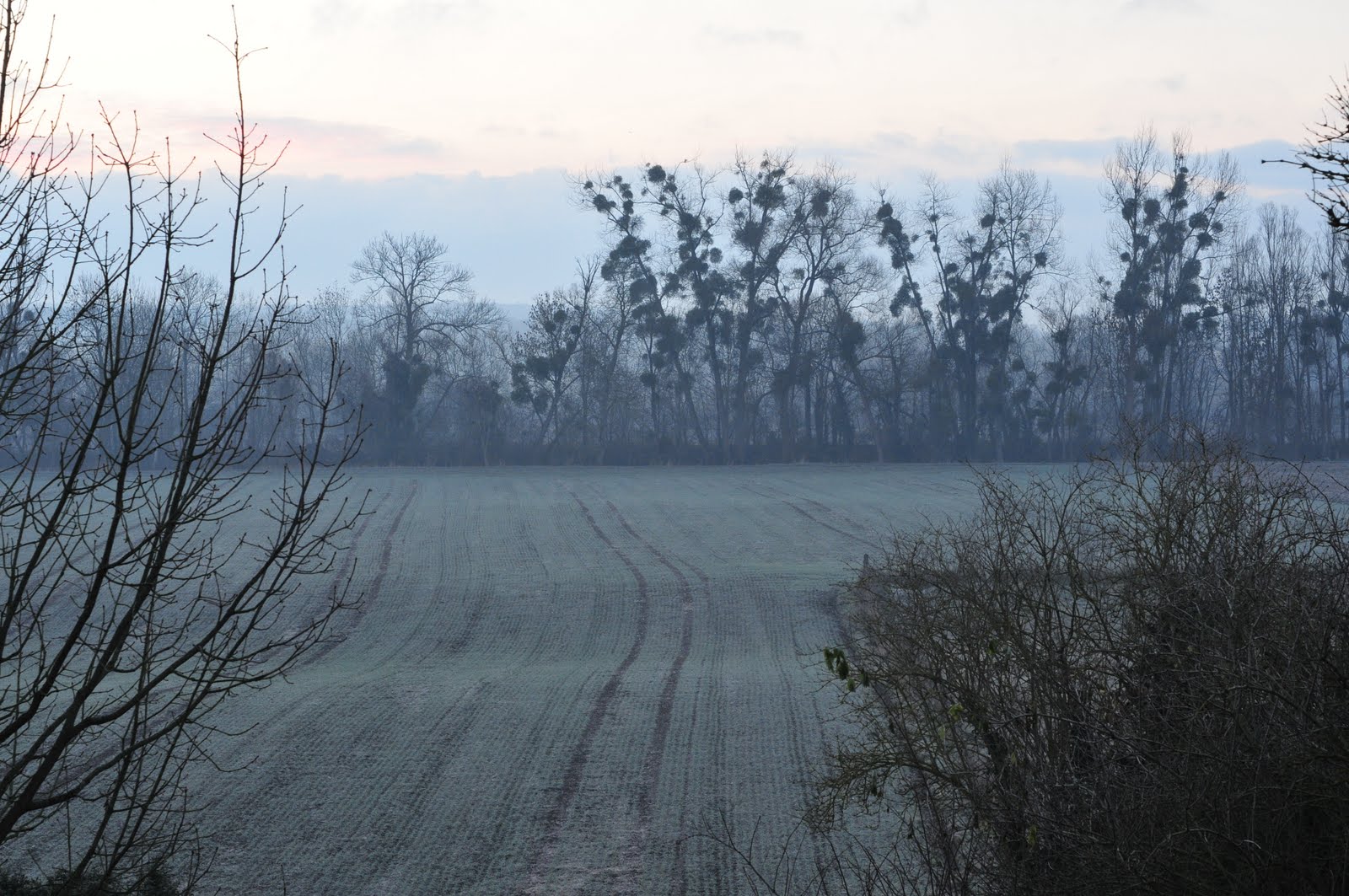
Frost on the fields
I find that the views I take here tend both to the distance and to the very close-up. It's the garden and the view. If they teach things other than how to kill and maybe manage not to kill a plant (they are hard, usually, to kill, especially when you don't want them, but even when you actually do) and how to get lost in thought, they teach you to look and to notice both the large picture of the world that surrounds you and the tiny details of that world.
This is very useful in times of difficulty, when you usually hear Keep your eyes on the big picture every time something goes wrong and your stamina threatens to quit. This is when it is time to notice the very small things and forget all about the big picture for 5 minutes. It's often the smallest things that will get you through and maybe even see your way to whatever goal you are presently cursing yourself for fixing yourself.
Goals are not what they are cracked up to be. You have to be very careful with them or you can get yourself in a lot of trouble, like when someone close to you says, "You take in dogs and cats, why not a child? Don't over rationalize it."
No, do. Do over rationalize it. I implore you.
But, you think You know, you're right. How noble. It's the right thing, really. Just do it. Swelling with all the nobility your breast can contain, suddenly you hear your very own voice saying to that child's other parent, the noncustodial one, "Let's take her."
Rather like that same parent did when our first Labrador Retriever breeder asked back in 2006 if we would take Baccarat's mother, Rapide, too. That time it was he who said, "We'll take her," and he regretted it ever since he pronounced the words into the low September noon sun.
Fateful words, those. Everything changes. You say them, and there is no going back, at least not until you have gone.
I prepared a contract while she prepared her things and he went to get her after work the next day. It was a statement of our parenting intention and how our household works, and a promise to fulfill our obligations to her in return for her promise to uphold our minimum expectations of her.
Her room having been a cross between a war zone and public dump since I have known her, a period nearing one decade, I decided to begin with a spotless room, emptied of all but essentials: books, school supplies, bed, beside lamp, desk, chair, desk lamp, laundry hamper, closet and drawers prepared and waiting. Everything dusted and vacuumed. It was to stay that way. No clothes strewn all over the floor, no tiny scraps of paper adorning every dusty surface, no bowls of Nestle Quick with a spoon burrowed into the back of the desk drawer, barrettes, beads, pen caps, markers, cards, bits of games, pouches, and worn orphan socks and inside-out underpants clogging the underside of the bed, the edge of the woven straw floor covering, collecting dust bunnies larger than her dwarf hamster. In exchange, she would do no heavy cleaning, no unfair share of household chores.
That's my job. That's why I got my degree in architecture.
She would also spend time in the living room and participate in family life, read with us in the evening, do her homework with her father and myself and accept our direction and help, learning to use her brain for reflection and deduction, refrain from using such winning phrases as "Je m'en fiche" (I don't care), "J'en ai marre" (I'm sick of ________), "J'ai pas" (I don't know in slang), "Ba --" (uh or well, as in "well" at the beginning of a feeble explanation), all pronounced in a tone of voice more suited to someone raised in a crack house and not the households of a midwife and a doctor and a cleaning lady with an architect's resume.
In return, she would have more free time in her room for her Nintendo DS and text messaging all her multitude of correspondents, more time at the stables, and the possibility of inviting friends over, as long as the grades are on an upward curve, right along with the attitude.
The first evening went beautifully. We sailed over obstacles that seemed on a level with the sand. By a few days later, as we embarked on a new week, the obstacles looked more like the high jump from our seat on the wide back of a Shetland pony without stirrups. We ran into more than a few, but here's the thing: with children, you are not allowed to give up. You must go on, and they are not anywhere near as cooperative, desirous of pleasing and devoted as your dogs, nor as capable as your cats. There is nothing whatsoever in common between opening your heart to animals and to children.
Nothing.
Dogs may fart and not excuse themselves for making the air temporarily unbreathable (where does the stink go when it goes away?), but they rarely poison the environment with supreme "je m'en foutisme".
Cats may let you know that you are superfluous to them until they decide you are not, but they will rarely let you know you would be welcome to die and go to hell until they need you to prepare another meal.
And yet, their parents love them, and their responsible non-parent steps actually care about them, at least because of their great caring for their spouse, if nothing else, which is not always the case. Sometimes it is because you notice something in the child, something that once you catch a glimpse of it, no matter that it might be fleeting, you cannot forget when they deride your hopes for them, and even those they have for themselves, with their most majestic and taunting insolence.
I dare you to believe in me. I will not. I will show you that you are wrong, and nothing will give me greater pleasure or satisfaction.
Even there, when you look very closely into their eyes, you can see the fear. A question. Panic.
These they wish they could hide, and if you tell them you can see them, if you let them know that you will not give them the conflict they are demanding, that you will not permit them not to back out of the hole they are digging for themselves and correct their behavior, they will tell you Tu n'es pas dans ma tête, and perhaps laugh with deep discomfort because you have visited inside their head and seen the broken furnishings, the scribblings on the wall, the disorder. It does not comfort them to know that you can see and that you will not run. If it does, you will not know this. They will not let you.
It would be best if you simply know and act accordingly.
It takes every ounce of self-mastery to remain calm, repeating the same messages, expressing the same confidence, guiding and commanding without appearing to order, avoiding -- at all cost to oneself -- that drug of dearly beloved conflict, for if anger is but sadness and fear in its most primitive expression, conflict is sadness and fear become active, and finally habit. It's all you can offer and all you can ask.
I suspected when I said "Alright, let's take her" that the peace I had known with her would be replaced with a struggle to the death to create conflict where there had been little to recreate the relationship she had with her mother. It made me soften a bit towards her mother, but not that much. That's another story. It's a novel, or a piece for the theater, for if things had gotten to this, it was not because of a faulty wire in the daughter's head that can be fixed by a psychologist or even better parenting. It is a whole system of poor wiring, created by genes on the one hand and chemicals from responses to the stimuli of a difficult family environment on the other, and it is going to take a team to awaken the unused sensory and intellectual paths to success.
So much easier to stay the paths of non-responsibility, conflict and pain learned by the committed je m'en foutiste, with that maddening angry glare and hysterical grin. But, you have seen something. The moments when it slips because genuine excitement and pleasure have momentarily left no place for anger and self-defense.
This is what you cling to. This is how the details get you to the big picture.
"Regards," I pointed to the kitchen table. My husband's eyes followed my arm and my extended finger to where the SIM card lay on the Nintendo DS. He nodded.
"Elle tient le contrat alors," he said to me, with a slight suggestion that I had accused her of breaking the contract merely by yelling at me that none of her other friends had to have one to live with their fathers.
"Si je te la monte c'est parce que je le sais," I replied.
If I brought his attention to her SIM card lying there in that spot after she had gone up to bed, I told him, it was because I know she is honoring the contract at heart, as best as she can, while fuming about it at the same time. I knew it was a gesture of cooperation, the most important thing we had asked of her other than trust and respect.
I took a bright pink Post-it note from the drawer and a black marker, and I traced the shape of the SIM card on it, placing an arrow pointing to the image of the card below and a smiley face inside. Then, I stuck it to its place on the DS where she had left it and lay the SIM card back down in its little home.
When she came down to find it on the way to school in the morning, she would find recognition and thanks, too. I hoped I would find more strength for another day, clinging to the smallest details.
The struggle itself is enough to make a woman happy.
She hopes and prays.
....
This is very useful in times of difficulty, when you usually hear Keep your eyes on the big picture every time something goes wrong and your stamina threatens to quit. This is when it is time to notice the very small things and forget all about the big picture for 5 minutes. It's often the smallest things that will get you through and maybe even see your way to whatever goal you are presently cursing yourself for fixing yourself.
Goals are not what they are cracked up to be. You have to be very careful with them or you can get yourself in a lot of trouble, like when someone close to you says, "You take in dogs and cats, why not a child? Don't over rationalize it."
No, do. Do over rationalize it. I implore you.
But, you think You know, you're right. How noble. It's the right thing, really. Just do it. Swelling with all the nobility your breast can contain, suddenly you hear your very own voice saying to that child's other parent, the noncustodial one, "Let's take her."
Rather like that same parent did when our first Labrador Retriever breeder asked back in 2006 if we would take Baccarat's mother, Rapide, too. That time it was he who said, "We'll take her," and he regretted it ever since he pronounced the words into the low September noon sun.
Fateful words, those. Everything changes. You say them, and there is no going back, at least not until you have gone.
I prepared a contract while she prepared her things and he went to get her after work the next day. It was a statement of our parenting intention and how our household works, and a promise to fulfill our obligations to her in return for her promise to uphold our minimum expectations of her.
Her room having been a cross between a war zone and public dump since I have known her, a period nearing one decade, I decided to begin with a spotless room, emptied of all but essentials: books, school supplies, bed, beside lamp, desk, chair, desk lamp, laundry hamper, closet and drawers prepared and waiting. Everything dusted and vacuumed. It was to stay that way. No clothes strewn all over the floor, no tiny scraps of paper adorning every dusty surface, no bowls of Nestle Quick with a spoon burrowed into the back of the desk drawer, barrettes, beads, pen caps, markers, cards, bits of games, pouches, and worn orphan socks and inside-out underpants clogging the underside of the bed, the edge of the woven straw floor covering, collecting dust bunnies larger than her dwarf hamster. In exchange, she would do no heavy cleaning, no unfair share of household chores.
That's my job. That's why I got my degree in architecture.
She would also spend time in the living room and participate in family life, read with us in the evening, do her homework with her father and myself and accept our direction and help, learning to use her brain for reflection and deduction, refrain from using such winning phrases as "Je m'en fiche" (I don't care), "J'en ai marre" (I'm sick of ________), "J'ai pas" (I don't know in slang), "Ba --" (uh or well, as in "well" at the beginning of a feeble explanation), all pronounced in a tone of voice more suited to someone raised in a crack house and not the households of a midwife and a doctor and a cleaning lady with an architect's resume.
In return, she would have more free time in her room for her Nintendo DS and text messaging all her multitude of correspondents, more time at the stables, and the possibility of inviting friends over, as long as the grades are on an upward curve, right along with the attitude.
The first evening went beautifully. We sailed over obstacles that seemed on a level with the sand. By a few days later, as we embarked on a new week, the obstacles looked more like the high jump from our seat on the wide back of a Shetland pony without stirrups. We ran into more than a few, but here's the thing: with children, you are not allowed to give up. You must go on, and they are not anywhere near as cooperative, desirous of pleasing and devoted as your dogs, nor as capable as your cats. There is nothing whatsoever in common between opening your heart to animals and to children.
Nothing.
Dogs may fart and not excuse themselves for making the air temporarily unbreathable (where does the stink go when it goes away?), but they rarely poison the environment with supreme "je m'en foutisme".
Cats may let you know that you are superfluous to them until they decide you are not, but they will rarely let you know you would be welcome to die and go to hell until they need you to prepare another meal.
And yet, their parents love them, and their responsible non-parent steps actually care about them, at least because of their great caring for their spouse, if nothing else, which is not always the case. Sometimes it is because you notice something in the child, something that once you catch a glimpse of it, no matter that it might be fleeting, you cannot forget when they deride your hopes for them, and even those they have for themselves, with their most majestic and taunting insolence.
I dare you to believe in me. I will not. I will show you that you are wrong, and nothing will give me greater pleasure or satisfaction.
Even there, when you look very closely into their eyes, you can see the fear. A question. Panic.
These they wish they could hide, and if you tell them you can see them, if you let them know that you will not give them the conflict they are demanding, that you will not permit them not to back out of the hole they are digging for themselves and correct their behavior, they will tell you Tu n'es pas dans ma tête, and perhaps laugh with deep discomfort because you have visited inside their head and seen the broken furnishings, the scribblings on the wall, the disorder. It does not comfort them to know that you can see and that you will not run. If it does, you will not know this. They will not let you.
It would be best if you simply know and act accordingly.
It takes every ounce of self-mastery to remain calm, repeating the same messages, expressing the same confidence, guiding and commanding without appearing to order, avoiding -- at all cost to oneself -- that drug of dearly beloved conflict, for if anger is but sadness and fear in its most primitive expression, conflict is sadness and fear become active, and finally habit. It's all you can offer and all you can ask.
I suspected when I said "Alright, let's take her" that the peace I had known with her would be replaced with a struggle to the death to create conflict where there had been little to recreate the relationship she had with her mother. It made me soften a bit towards her mother, but not that much. That's another story. It's a novel, or a piece for the theater, for if things had gotten to this, it was not because of a faulty wire in the daughter's head that can be fixed by a psychologist or even better parenting. It is a whole system of poor wiring, created by genes on the one hand and chemicals from responses to the stimuli of a difficult family environment on the other, and it is going to take a team to awaken the unused sensory and intellectual paths to success.
So much easier to stay the paths of non-responsibility, conflict and pain learned by the committed je m'en foutiste, with that maddening angry glare and hysterical grin. But, you have seen something. The moments when it slips because genuine excitement and pleasure have momentarily left no place for anger and self-defense.
This is what you cling to. This is how the details get you to the big picture.
"Regards," I pointed to the kitchen table. My husband's eyes followed my arm and my extended finger to where the SIM card lay on the Nintendo DS. He nodded.
"Elle tient le contrat alors," he said to me, with a slight suggestion that I had accused her of breaking the contract merely by yelling at me that none of her other friends had to have one to live with their fathers.
"Si je te la monte c'est parce que je le sais," I replied.
If I brought his attention to her SIM card lying there in that spot after she had gone up to bed, I told him, it was because I know she is honoring the contract at heart, as best as she can, while fuming about it at the same time. I knew it was a gesture of cooperation, the most important thing we had asked of her other than trust and respect.
I took a bright pink Post-it note from the drawer and a black marker, and I traced the shape of the SIM card on it, placing an arrow pointing to the image of the card below and a smiley face inside. Then, I stuck it to its place on the DS where she had left it and lay the SIM card back down in its little home.
When she came down to find it on the way to school in the morning, she would find recognition and thanks, too. I hoped I would find more strength for another day, clinging to the smallest details.
The struggle itself is enough to make a woman happy.
She hopes and prays.
....


 Articles


